


Why Sand Patches for Wild Bees?
What can we do to promote biodiversity in our gardens? How can we help insects find a suitable nesting site and at the same time support the growth of our vegetables and fruits? The worldwide bee mortality is influenced by various factors, including above all the destruction of habitat and food sources. But without bees, food for us will also become scarce, because these small diligent animals pollinate around 80% of our cultivated and wild plants.
Did you know that half of all wild bee species nest in the ground? Those who take the trouble to design a part of their garden accordingly will soon be rewarded by many wild bees quickly colonizing the newly created nesting sites. Open, sunny sand patches that are uncultivated or sparsely vegetated are particularly suitable for ground-nesting bees.
Martina Nommsen from the Family Gardens Association Dübendorf provides a simple guide in this guest article on how to create an attractive area for ground-nesting bees.
Guest article from the Family Gardens Association Dübendorf
Wild Bees and the Soil
With a wild bee hotel or a wild bee paradise, you promote pollination in your garden and can experience nature up close. This is also a special experience for small garden explorers, as wild bees sting much less often than honey bees! Thus, the wild bee paradise project is also suitable for a family garden.
With a BeeHome in your garden, on your terrace, or balcony, you offer a home to about one-third of wild bees. But did you know that two-thirds of all wild bees nest in the ground? For this, we at Wildbiene+Partner, in collaboration with Ricoter Schweizer Erde, have developed a special wild bee sand that meets the requirements of ground-nesting bees. With this sand (available online here), building your own bee hotel is child's play.
And here is the building instruction – Create a sand patch for wild bees yourself
What do you need? A sunny and dry spot – whether in the garden, on the terrace, or the balcony. Because the bee sand can also be used perfectly in pots and thus helps even in the smallest spaces.
In my garden in the Ifang area, I planned the wild bee paradise project on an empty bed of about two square meters. If you want to create a sand patch with the dimensions listed below, you will need about 25 kilograms of gravel and 120 liters of wild bee sand (20kg for 10.95 CHF available online here).
Tools used:
- large shovel
- small shovel
- gloves
Building materials used and approximate price:
- Gravel: CHF 5
- Bee sand 120 liters: CHF 66
- Wood: CHF 10
Step 1: Digging a pit
First, dig a pit 60 cm in diameter and 30 cm deep for your sand patch.

Step 2: Gravel as drainage
The ground is covered with coarse gravel as drainage to ensure water permeability for the sand area. Note that I used finer gravel for this project.

Step 3: Fill with wild bee sand
Directly on top of the gravel goes the finely structured and thus easily moldable wild bee sand, which is lightly compacted so that the pollinators can easily burrow into it.

Step 4: Build a sand lens
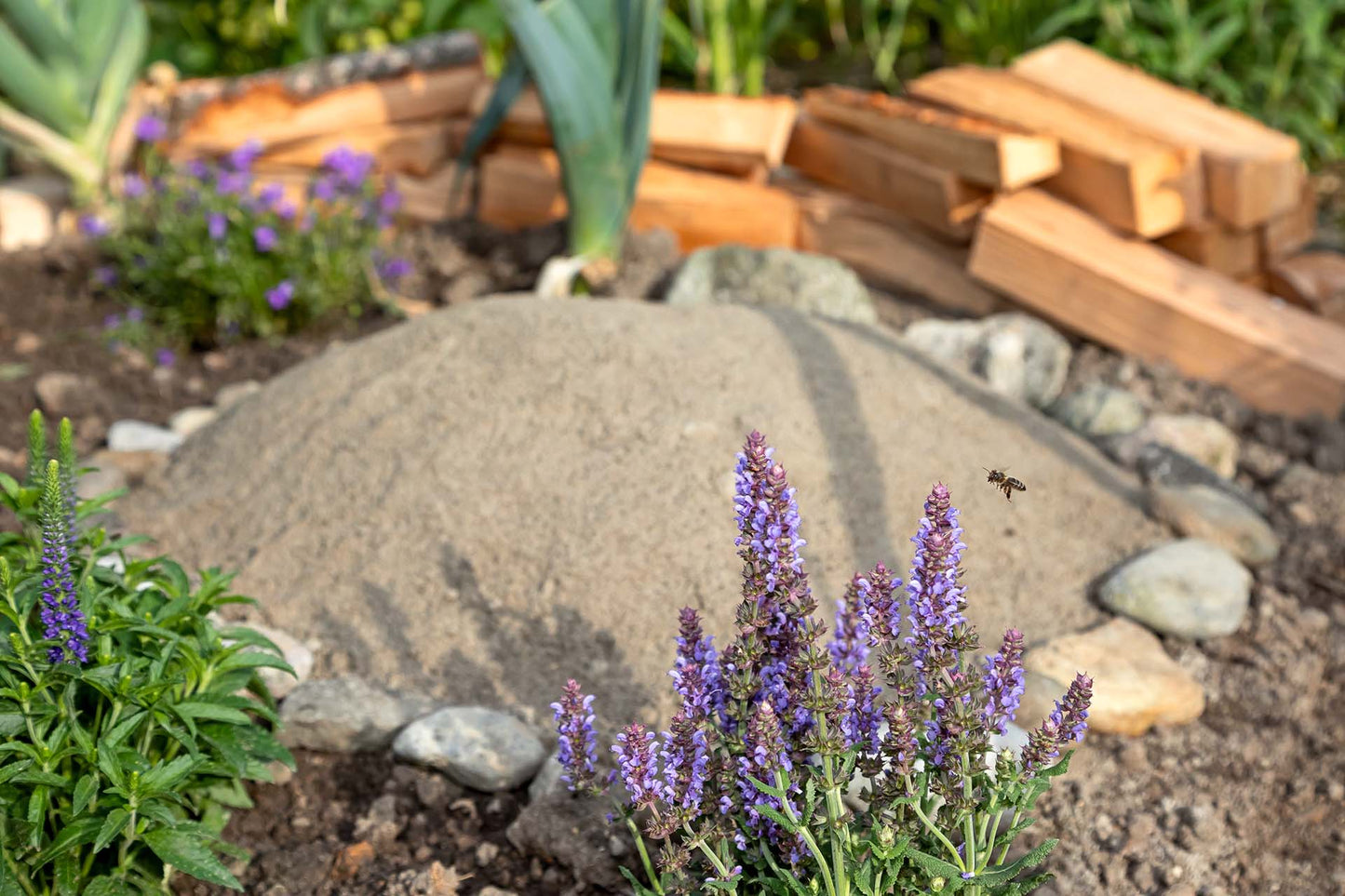
To create a proper sand lens, form a sand dome about 30 cm high on this surface and lightly compact it. I surrounded the sand lens with stones for aesthetic reasons.

Now I'm still looking for empty snail shells. Why? That's exactly where the snail shell mason bee seeks its nesting site. I will place the snail shells next to the stones at the edge of the sand patch. Wild bee expert Yannick from Wildbiene+Partner explains in this video how you can support the snail shell mason bee with snail shells.


Spiked speedwell (left) and Wall germander (right):


The small scabious (Scabiosa columbaria, left), whose beautiful pale purple blossoms attract numerous wild bee species, blooms from May to September, and Bellflower (right):


Further information on wild bees
A great list of suitable wildflowers and much more information about wild bees in general can be found, for example, on the website of Wildbiene + Partner.
What else should be considered when creating a sand patch for wild bees? Ricoter Schweizer Erde offers an informative video on building a sand lens and also describes how you can use wild bee sand on the balcony.
In the photos, you can also see natural wood stacked lightly on the side, which is also intended to serve as a nesting site for wild bees. Some wild bees build their nests in rotten tree trunks. Wood located in warm and dry places, in particular, magically attracts these heat-loving insects.
Conclusion
By providing a home for wild bees, you not only do something good for insects but also promote biodiversity. And this benefits not only the bees but especially your garden.
About the Family Gardens Association Dübendorf
Sustainable gardening and harvesting in the family garden: «We are an association for family gardens in Dübendorf with 226 plots. We enjoy gardening in our free time in nature. In the family garden, we support biodiversity and the cultivation of local plants, such as fruits, vegetables, herbs, berries, and flowers.»
The most important goals of the association are:
- Promotion of biodiversity and sustainability
- Nature-friendly gardening without the use of pesticides
- Promoting connection to the environment and nature for young and old
- Fostering neighborly relationships among members
- Enjoying the garden as a place of peace and relaxation