


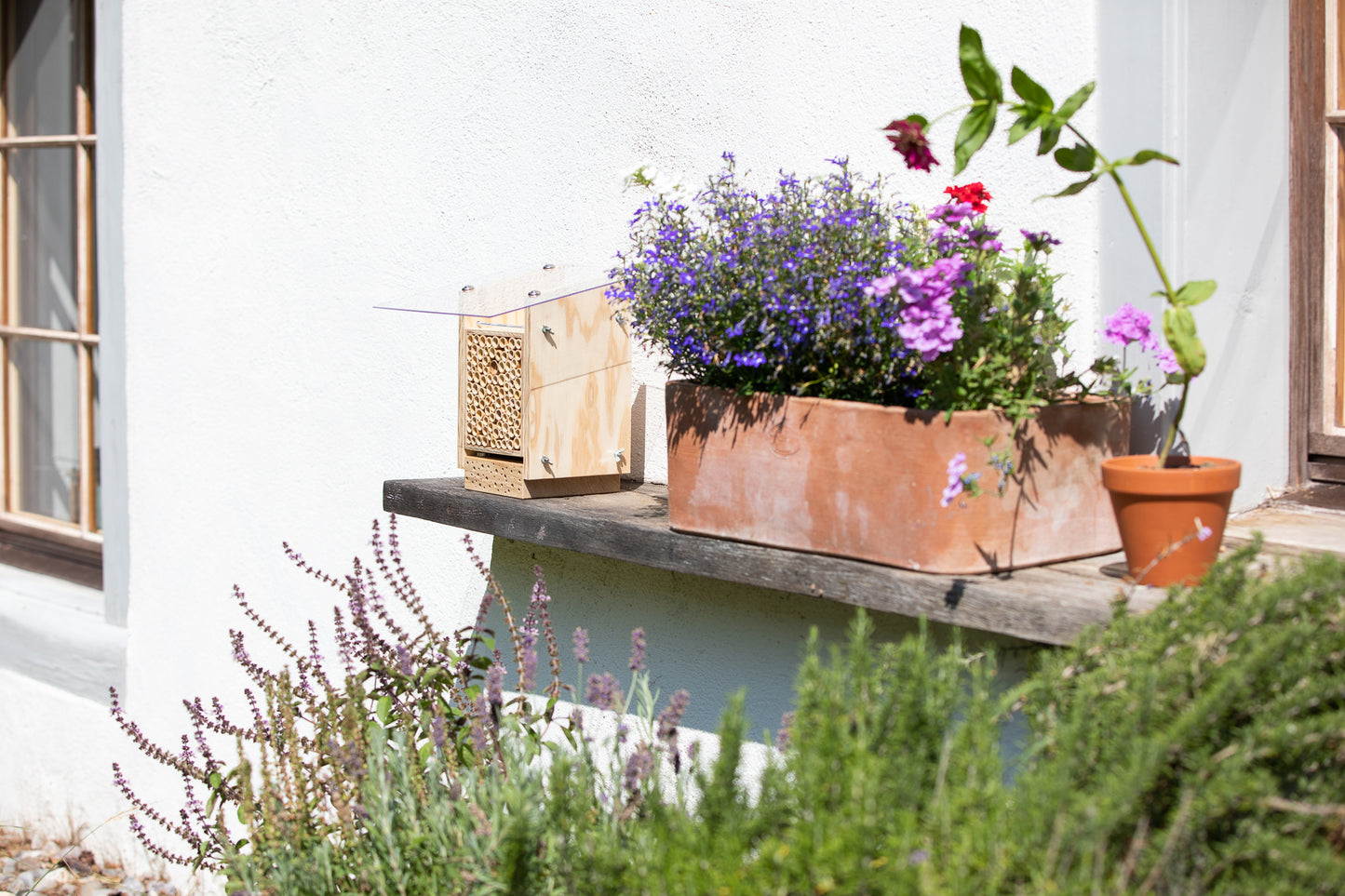
By early June at the latest, the mason bees will have finished nesting. The BeeHome can then become a nesting site for other fascinating wild bee species. Keep an eye on your BeeHome and you might discover one of these five common wild bee species. You can easily identify them by their different nest closures.
1. The Blue Mason Bee
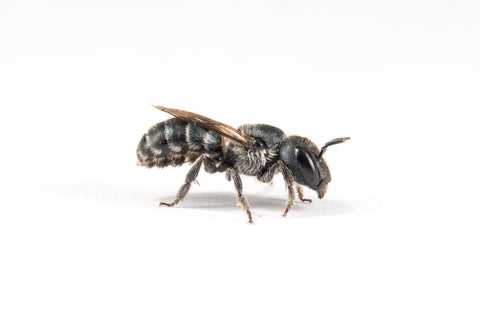
The blue mason bee (Osmia caerulescens) is noticeable for its shimmering blue body and rather coppery to metallic green coloration. It uses chewed leaf material for its cell partitions and nest closure. It partly camouflages the nest closure with other materials, such as wood fibers.
The blue mason bee can be observed twice a year as it produces two generations per year. This distinguishes it from most other wild bee species. The first generation is active between April and July. The eggs laid during this time develop rapidly, so the second generation of bees hatches between mid-July and mid-August.
The blue mason bee mainly collects pollen from legumes and mints. It loves bird's-foot trefoil, sainfoin, hedgenettle, and motherwort.
Males and females are easy to distinguish: a male on the left and a female in the middle. On the right, you can see what the nest and nest closure of the Blue Mason Bee look like.

2. The Garden Leafcutter Bee

The leafcutter bee (Megachile willughbiella) is a true specialist, using its mouthparts, the mandibles, to cut leaf pieces up to 2 centimeters long, while it measures only between 12 and 15 millimeters itself. It uses rose, oak, or hornbeam leaves. The nest closure is easy to recognize. It consists of many individual leaf pieces.
The leafcutter bee is polylectic. This means it doesn't specialize in a single plant species for collecting pollen. It still has its favorites, though: legumes, composites, stonecrops, bellflowers.
The leafcutter bee is active from June to August. If it's warm enough, a second generation can even be spotted in mid-August. It overwinters as a larva and can also nest in the ground, for example, in a flowerpot. Here you can see a leafcutter bee bringing a leaf piece into the nest (right), with the bitten-off pieces often larger than the bee itself (middle image). On the right, the nest and nest closure of the Garden Leafcutter Bee are shown.

3. The Bellflower Scissor Bee

The name says it all. The Bellflower Bee (Chelostoma rapunculi) only has eyes for bellflowers. This wild bee is oligolectic: it exclusively collects pollen from bellflowers.
The female seals her nest with clay and adorns the cap with small stones. Additionally, she uses nectar to make the structure very solid, but also slightly sweet. This is why ants can sometimes be seen trying to nibble at this mixture.
It's remarkable that the next generation's offspring can chew their way through this solid wall upon hatching. The nectar has a small disadvantage for the BeeHome: it can seep into the tubes and create black spots. Bellflower bees are active from June to August.
4. The Truncated Resin Bee

The truncated resin bee (Heriades truncorum) is the smallest of these five wild bee species. The truncated resin bee is common and can be observed in many gardens. If you look closely, you can see how it picks up pollen into its abdominal brush with swaying movements on its host plants. With its small size and black color, it is rather inconspicuous. It is much easier to recognize when the truncated resin bee has collected pollen on its abdomen.
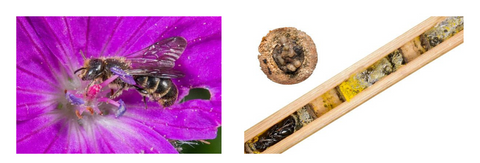
It specializes in plants of the composite family (for example: ox-eye daisy, dyer's chamomile, tansy, or chicory). In the picture, you can see the truncated resin bee on chicory, as well as the nest and nest closure of this species.

5. The Viper's Bugloss Mason Bee

The viper's bugloss mason bee (Hoplitis adunca) is one of the most specialized wild bees in Europe. It only collects pollen from viper's bugloss flowers and is therefore critically dependent on the presence of this plant. About half of the offspring hibernate for one winter, while the other half sleeps for two winters until they hatch. In this way, this wild bee species can survive years in which little or no viper's bugloss grows. Viper's bugloss mason bees are active from July to August. Here you can see them in action:
Anyone who wants to observe them should definitely ensure a sufficient stock of viper's bugloss. On warm days, the viper's bugloss mason bee is very fast and collects pollen and nectar at a rapid pace. To recharge energy and warmth, it often settles on sunlit stones between foraging flights.
For the partition walls of the brood cells and for the nest closure, this species uses loamy soil. In addition, it camouflages the nest closure with various materials such as wood fibers (see right image).
In the left image, you can see two viper's bugloss mason bees fighting over a nesting site:

Discover rare wild bees in your garden
Our BeeSummer easily extends your BeeHome, popular with mason bees, into a valuable home for many other wild bee species. You also receive our illustrated Wild Bee Booklet, which makes identifying BeeSummer guests child's play. Offer a home to rare wild bee species too, such as the small masked bee!

Just like our wild bee house, the BeeSummer is exclusively produced in Switzerland in social workshops. The nesting block, made of FSC-certified, solid Swiss oak wood, can be easily attached to your BeeHome without any tools. With numerous nesting tunnels in various diameters, you provide optimal habitat for various wild bees.