


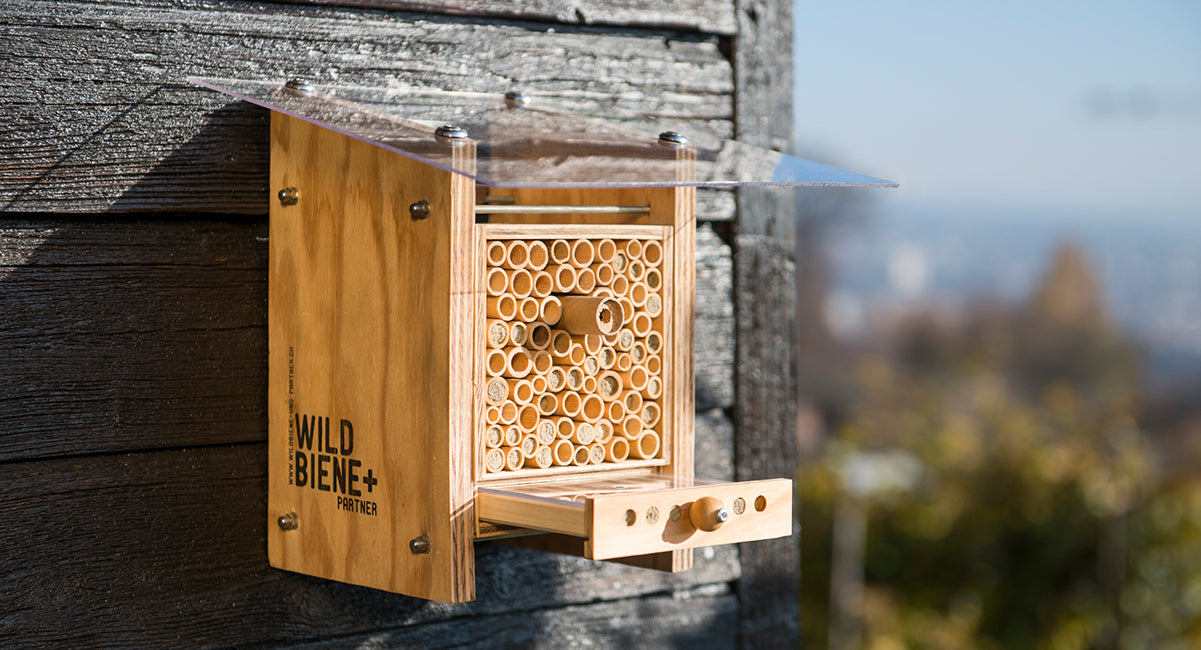
Are you attached to your BeeHome and your wild bees and would you like to pamper them? With humidity and over the years, the wood can turn black and mold can appear. Here are some tips on how to care for your BeeHome.
Linseed oil to care for your BeeHome
Linseed oil is known for its beneficial effect on wood. Since our wood is untreated, water can penetrate through the pores if the house is too exposed to the weather. When linseed oil is applied, the product fills these spaces and smooths the surface so that water can run off without penetrating. For care, the wood of the BeeHome should be absolutely dry and clean. When you are sure that your BeeHome is no longer damp, apply two coats of linseed oil, letting the first coat dry for 24 hours before applying the second coat.
Help your BeeHome to new freshness
You may find mold at the entrance of your tubes - especially if your BeeHome is not in a sunny location. However, mold is not problematic for wild bees. It is more of an aesthetic problem.
If you want to give your BeeHome a fresh look, you can clean the entrance of the unobstructed tubes with a brush or sandpaper. This does not pose a risk to the BeeHome or the wild bees. Afterwards, you can apply two coats of linseed oil to the wood to protect it from moisture.
In order not to disturb the wild bees, we recommend that you carry out this care when they are in hibernation. This is in autumn or towards the end of winter on a beautiful sunny day.
Due to the humidity, the drawer of your BeeHome Observer may be difficult to open. This is due to the wood soaking up water and swelling. If you encounter this phenomenon on your BeeHome, wait until the wood is dry, pull out the drawer (press the stopper below the drawer) and sand the sides of your drawer to make it easier to pull out. Remove the dust and then apply two coats of linseed oil to protect the wood. Let it dry and then put the drawer back in your BeeHome. With this care, your BeeHome will be like new again!

Care for the location of your BeeHome
To avoid the phenomenon of blackening, the location is very important. If your BeeHome turns black too quickly, your house is undoubtedly too exposed to the weather.
We recommend a setup with more than 50cm of ground, oriented from northeast to south (ideally an orientation with morning sun). A tree, complete shade or a damp environment should definitely be avoided.
If you have persistent problems with mold, you can try to reposition the house so that it gets more sun. You can install a protective wall to protect it from bad weather. This is especially true if you have set up your BeeHome in the garden.
Protect your BeeHome before autumn/winter
When the days get shorter and colder and no more bees fly around your BeeHome, place it in a protected place. It is important for your wild bees that the house stays outside. The small creatures do not tolerate warm indoor temperatures well.