


Climate change is here. Is it just knocking at the door? Will it force its way in? Climate scenarios look different depending on how much CO₂ we emit. But one thing is already clear today: innovative solutions for climate adaptation are needed – from all stakeholders. One should start on one's own doorstep. 75 percent of the Swiss population lives in urban areas. They are particularly affected by more frequent and stronger heatwaves. This is because cities and the surrounding agglomerations have a high proportion of sealed surfaces.
Our Sustainability Manager, Juliana Klose, has written an article for the Green Economy Special of Handelszeitung about heat mitigation measures in urban areas:
Unseal, plant, shade
Entire streets, public squares, and commercial areas have been sealed with asphalt. What few people think about is this: The dark asphalt heats up noticeably. Heat islands emerge. Nobody likes to linger in these places. People need retreats. The nearby park, the green oasis of one's own garden, the meadow by the blue lake. Places where our soil can still breathe. What happens there is enormous. Soil is considered the most biodiverse habitat on Earth. It forms the basis for plant diversity. We should therefore treat our planet's green skin with corresponding care. Because green spaces cool!
In times of climate change, this aspect is particularly relevant for urban planning. When rainwater seeps into the soil and is stored by plants, it can evaporate again on hot days. Evapotranspiration provides cooling.

The climate maps of the Canton of Zurich show:
In cities, it is up to 10 degrees hotter than in the countryside. Thomas Stoiber is responsible for measures against heat at the Zurich Office for Waste, Water, Energy and Air (Awel). As co-head of Climate and Mobility, he sees a great need for action to ensure that cities remain attractive places to live and work. Because tropical nights with temperatures above 20 degrees Celsius lead to poorer sleep at night. Extreme heat also reduces a company's work productivity.
But relief can be created. Stoiber recommends "more green and blue instead of gray." Instead of asphalt deserts, a climate-adapted city should have many trees and green spaces, with water elements providing additional cooling. Unseal, plant, shade. For him, these are the most effective measures. Especially trees. We will have to rely on them. Trees also interest Arthur Gessler. He researches forest dynamics and ecosystem ecology at the Swiss Federal Institute for Forest, Snow and Landscape Research WSL. "To benefit from ecosystem services, nature must return to the cities."
Deadwood also represents an important habitat for a variety of animals, fungi, plants, and lichens. In addition to the biodiversity aspect, the high water storage capacity of deadwood is interesting for urban planning. In particular, rotten wood has the potential to function as a nature-based solution in sponge city projects.

Wild Bee Paradise à la ETH
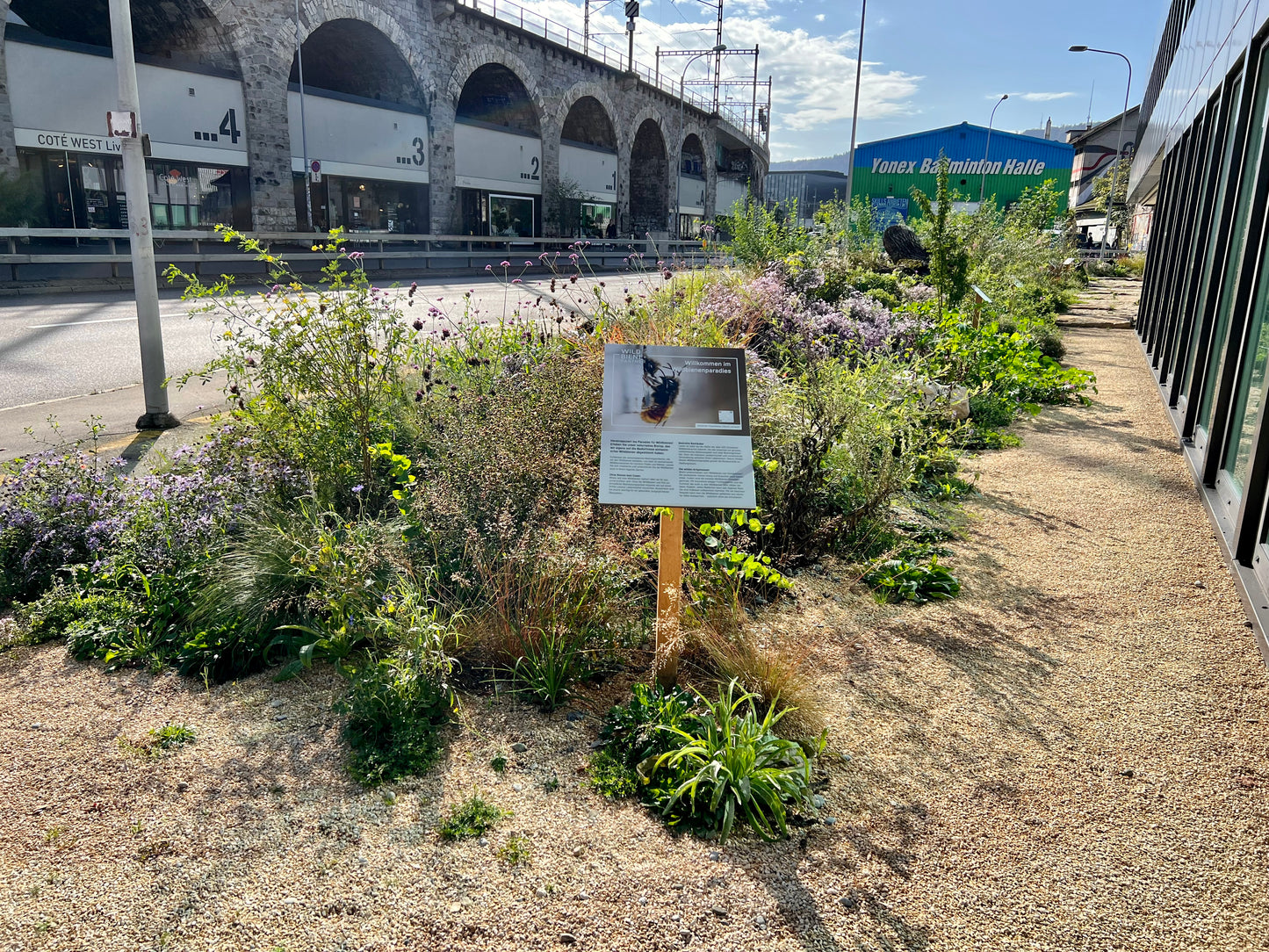
The ETH spin-off Wildbiene + Partner has been committed to biodiversity since 2013. This has resulted in near-natural areas in urban spaces. On flat roofs, above underground car parks, in residential areas. Meanwhile, "Wild Bee Paradises" exist, for example, in the cantons of Zurich, Lucerne, Grisons, Neuchâtel, and Thurgau. It is worthwhile to consider biodiversity from the outset in urban projects. This creates valuable synergies in measures against heat or photovoltaic systems on roofs. Wildbiene + Partner takes over the specialist planning for biodiversity, material supply, planting, and care.
A business model with social and ecological added value: In addition to the incredible plant diversity, one can discover sand lenses, pithy stems, dead wood, and rootstocks in the middle of the city. Endangered wild bee species thrive. Other insects such as butterflies, as well as birds, amphibians, and reptiles, benefit from the near-natural environmental design. Information boards with digital content inform passers-by about wild bees and the structures they depend on. Because biodiversity primarily means one thing: a zest for life!

Check out the Zürcher Kantonalbank blog! In the time-lapse video, you can watch how their gray concrete area transformed into a blooming bee paradise within a few months! It's even more exciting, of course, to visit the wild bee mile: Zürcher Kantonalbank, Neue Hard Südkurve, Zurich. Enjoy exploring!