


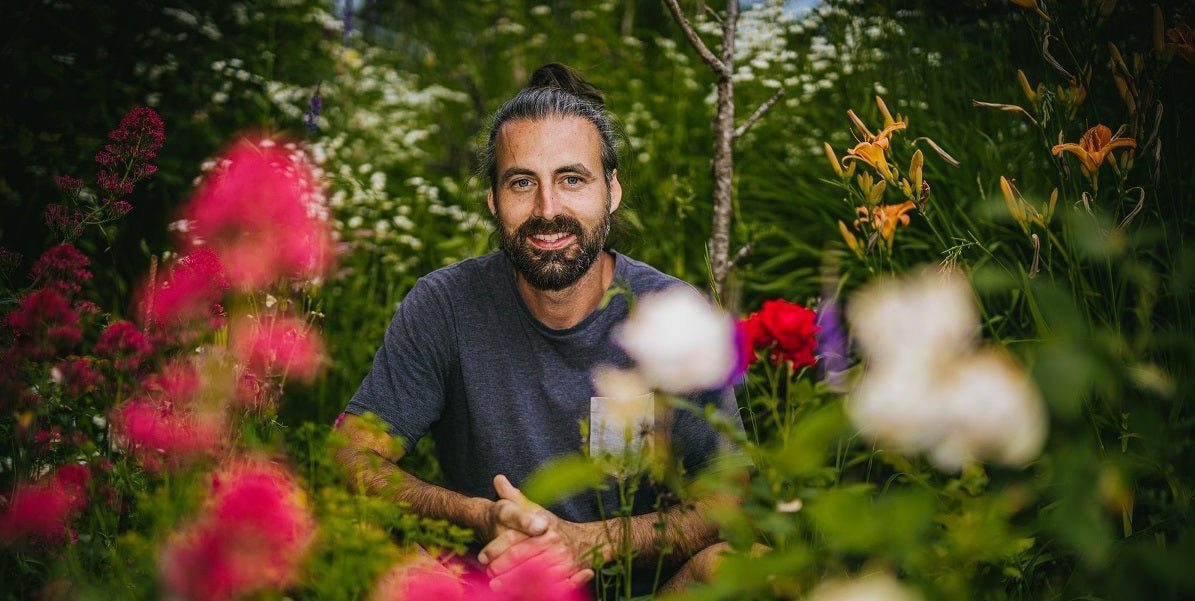
Wild bees need our help now more than ever. It's a good thing there are people like Yannick Schauwecker. For him, these buzzing harbingers of spring are a hobby, passion, and profession all in one.
Yannick Schauwecker drops everything for wild bees. Even the fragrant coffee in his large natural garden. "Sorry, I have to go after that leafcutter bee," he says in the middle of the interview. He grabs his camera from the garden table and unerringly follows the flying black dot to the peonies, which bloom here on the outskirts of Zurich next to a sea of wildflowers. Yannick doesn't lose sight of the wild bee until it lands on a rose leaf. "Amazing," he whispers, snapping one close-up after another. How the leafcutter bee gnaws a large piece out of a rose leaf with its strong mandibles, finally rolls it up, and rides through the air on this green tube. In its nest, it uses it to build a soft bed for its young, the father of two later explains with sparkling eyes. "I've never been able to photograph a garden leafcutter bee cutting leaves. That's awesome."
Yannick's enthusiasm is infectious. The 34-year-old loves to draw others into the fascinating world of wild bees in his naturally relaxed way. His excursions and lectures, which he regularly offers, are extremely popular. "This big black bumblebee here is a carpenter bee, my favorite species. Look how it checks me out while flying." Indeed. Unlike other wild bees, which take no notice of humans, the carpenter bee hovers in the air for a few seconds to fixate on Yannick's head with his thick beard and dark mane. Then it buzzes off.

So that's where the holes in the leaves come from. The leafcutter bee uses the cut-out leaf pieces to build a soft nest for its young.
Yannick's huge garden is a blooming, buzzing insect and, above all, wild bee paradise. The environmental engineer, who once worked as a chemical laboratory assistant, cares for it with great passion. Up here on the slope, the important pollinators find everything they need. Over 300 wildflower species and perennials bloom in the spring sun, and numerous wild bee species find nesting sites on artificial sand areas, in stems, deadwood blocks, and large nesting boxes. Last autumn alone, the wild bee enthusiast planted over 1000 flower bulbs so that his protégés can buzz through the colorful pollen and nectar oasis from spring onwards. He finds it exciting how everything suddenly shoots out of the ground from nowhere every year. "In February, everything is bare, and three months later you can't get through the jungle anymore," says Yannick, watching a mason bee fly by.
The plants led him to wild bees
The environmental engineer came to wild bees like many other experts: through plants. As a student at ZHAW (Zurich University of Applied Sciences), he was captivated by the subject "Native Flora and Fauna". "Before that, I could barely recognize a dandelion. When I then got to know the diversity of buds, species, and special features, I was immediately fascinated by this new world," Yannick says with the cold coffee in his hand.
But what are plants without insects? So at some point, Yannick went to a lecture about Hymenoptera, which also include wild bees. "And that's when it caught me," remembers the man his colleagues at Wildbiene + Partner simply call the wild bee whisperer. From then on, he gathered information about wild bees from every corner: in books, on the internet, and especially by photographing them in nature. Because photography is another passion of the Zurich nature lover. "That's also an advantage of wild bees: you can photograph them and the beautiful flowers incredibly well." And he does that everywhere: in Zurich and its surroundings, in the Alps, wherever he goes. "The first thing I do on holiday is to check which wild bees are there. With the camera, of course." Other hobbies? No, wild bees come first.
Wild bee enthusiast out of passion
Yannick is one of the few people who have been able to turn their passion into a profession. At Wildbiene + Partner, he is the man for wild bee paradises: small to medium-sized facilities where these important pollinators, especially endangered ones, find ideal conditions. Yannick designs these wild bee oases for urban or rural areas and wields a spade and hoe himself on site. He and his colleagues have already created more than 23 BeeParadises totaling over 20,000 square meters, and the number grows every year. Wild bees readily accept the new habitats, as counts show. After just two years, over 100 wild bee species can have settled in the newly created habitats.
Yannick is particularly pleased about this. "Because it shows that we can all make a quick difference with new, wild-bee-friendly habitats. Even a properly planted garden or a small city balcony is enough," says Yannick. So you don't have to drop everything to help wild bees. It's enough that there are people like Yannick who are happy to continue doing so in the future.
About the person: Yannick Schauwecker (34) lives in Zurich with his girlfriend and two children. He studied Environmental Engineering (ZHAW) in Wädenswil on Lake Zurich and previously gained diverse practical experience: among other things, as a chemical laboratory assistant, gardener, florist, carpenter's assistant, and school visitor for the WWF. The nature lover not only enjoys looking at wild plants but also uses them as ingredients when cooking – preferably over an open fire.
6 questions for Yannick
Yannick, why are wild bees actually important?
Wild bees play a key role in our ecosystem. Among other things, they ensure that the many native wild plants are pollinated. This is the only way they can produce fruits and seeds to reproduce. Without wild bees as versatile and efficient pollinators, many wild plants would soon disappear. And that would lead to an enormous loss and a severe impoverishment of biodiversity.
Why do wild bees need our help?
Poisons, over-fertilized meadows, cleared landscapes, and the widespread desire to keep outdoor areas meticulously tidy are the biggest threats to our wild bees. However, diverse and near-natural habitats are vital for their survival. Wild bees need native wildflowers in their environment to provide themselves and their offspring with pollen and nectar. Therefore, it is crucial that we once again give space to wildflowers and create microstructures: with deadwood, open soil patches, and dry plant stems.
How can wild bees be promoted?
There are many possibilities here. The most important help for the home balcony or garden is actually relatively easy to implement:
- Avoid poisons in the garden.
Does an insect hotel in the garden or on the balcony really help?
It helps many wild bee species greatly. Especially if many native plants are already growing in the vicinity. Because then the important pollinators have almost everything they need to live and nest: food and a nesting site. The additionally required material for the nests or nest closures, such as clay, leaf wool, or leaves, is usually abundant. Wild bees can be observed up close with a nesting aid at home. They also don't sting or bother you while you're eating, so you can safely settle them on your balcony or in your garden. For some species, wild bee houses are an excellent substitute for natural nesting sites that have become rare, for example in dead trees.
Does wild bee promotion also help other insects?
Yes, that's right. Where many wild bee species occur, plant and animal diversity is always high. Therefore, many plants, insects, and other animals automatically benefit from wild bee promotion.
What's your favorite wild bee?
I find carpenter bees very impressive. Not only because of their size but also because of their fascinating behavior. When they see a person nearby, they buzz around them, as if to check them out: friend or foe? And then they fly on, drill their nesting holes in deadwood or collect pollen.