


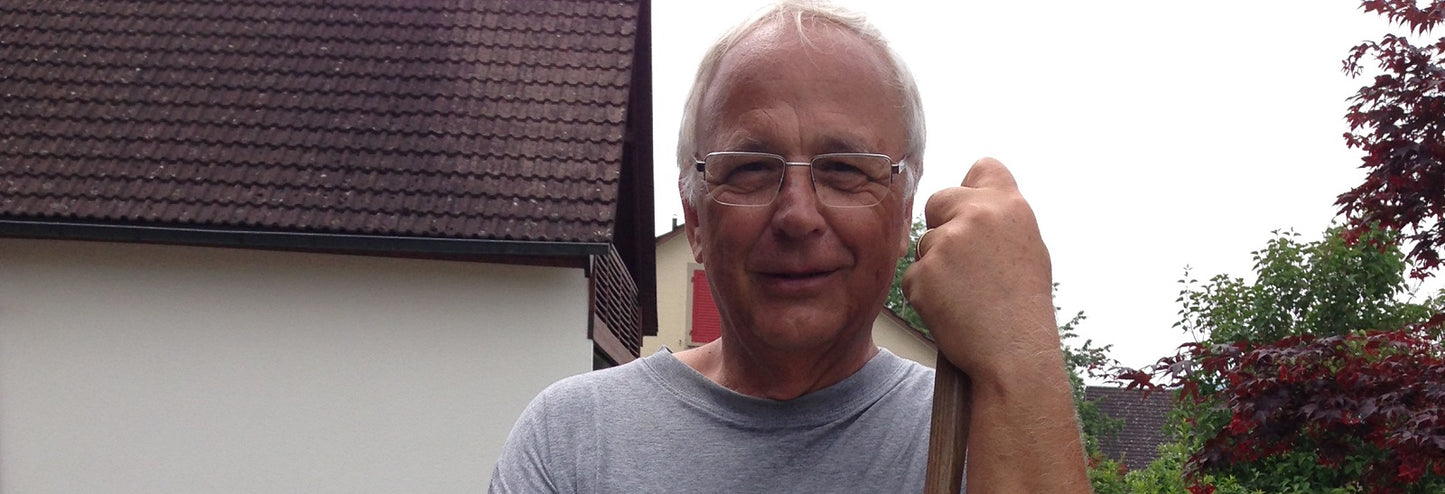
How does a hostile standard garden become a flourishing paradise for thousands of insects and wildflowers? It's simple: go-getters like Ernst Denzler have to discover their love for wild bees. Here is his incredible story.
On the first call, he didn't have time: Ernst “Aschi” Denzler was in the garden with sandpaper and linseed oil, winterizing his BeeHomes. “If you treat them like this, they look like new again even after years of full occupancy,” recommends the wild bee fan from Othmarsingen in the canton of Aargau. But maintenance takes time, he added. After all, he has 16 BeeHomes, 5 BeeHome Observers, several BeeSummers and a large BeeHome Diversity.
Four hours later, Aschi is calm enough to tell his story in detail: how he came to wild bees, why he wanted to transform his garden into a large paradise for insects and other animals, and why garden coffee tastes best to him early in the morning.
BeeHome is the starting signal for the garden redesign
Ernst Denzler's story is a bit crazy. A single day in Zurich was enough to turn a normal garden owner into an active wild bee hero. “In 2013, on my way to Zurich, I heard about the startup Wildbiene + Partner, and that same evening I was inspired by a lecture by wild bee expert Paul Westrich,” says Denzler. The message got through: wild bees need help. The very next day he ordered his first BeeHome – and was sorely disappointed. After two weeks, all the mason bees that had hatched had disappeared. Aschi immediately picked up the phone. “I wanted to complain to the founder Claudio that the BeeHome didn't work at all,” Denzler laughs. During this phone call, Aschi quickly saw the light. “Claudio asked me what plants I had in the garden. And then it immediately dawned on me: the bees didn't have anything to eat at my place,” Aschi recalls the conversation.
 Not only insects feel at home in Ernst Denzler's natural garden. Here you can see some of the many animal inhabitants in the green oasis in Othmarsingen. Images: Ernst Denzler
Insect paradise instead of vegetable patch
After such a realization, others plant insect-friendly wildflowers in a corner or let part of the lawn grow wild. That wasn't enough for Ernst Denzler. His entire garden, including the unloved vegetable patch, was to become a flourishing paradise for wild bees. He devoured books on natural gardens, planned and got started. “I ripped out the old, useless plants, dug everything up and replanted it. I spread 5 cubic meters of gravel with a shovel and carted large stones by car,” Denzler reports.
“I ripped out the old, useless plants, dug everything up and replanted it.”
Then he planted – one after another – wildflowers where insects can find pollen and nectar. And then the 1000 square meter plot bloomed. A single BeeHome turned into over 20 with lively buzzing from spring to summer.
Aschi also argues with his wife for the bees
He mowed the lawn for now. But at some point, he had enough of this flowerless green. “For a week I argued with my wife about this useless area. Now it's a lively meadow,” the stubborn insect friend says happily. “I just think bees are great. What they do! They fly around all day collecting pollen and nectar. I could watch insects work all day.”
And so, since 2013, Aschi has been transforming his garden year after year into a paradise for the buzzing pollinators. At first, he mainly focused on wild bees and honeybees, then he noticed more and more bumblebees and butterflies. “It's incredible how the garden has developed. I now see insects everywhere here,” says the 74-year-old, who is most impressed by the imposing blue-black carpenter bee. The property has long been a habitat for many other animals: martens, hedgehogs, spiders, frogs, woodpeckers. “Today we have birds here that I have never seen before,” Aschi says.
Aschi's award-winning nature paradise
He never runs out of work. “When my two grandchildren visit, they have to look for Grandpa between all the plants in the garden, weeding or digging,” says the busy Aargauer, whose career counselor recommended a green profession to him back then.
Aschi likes to show what's going on in his natural garden. On his homepage, on Facebook and Instagram, he uploads interesting films and many photos that make you want to experience buzzing nature on your doorstep. In the SRF initiative for more biodiversity Mission B, his green oasis even makes it into the trailer. “I was amazed when I saw my own wheelbarrow on TV for a week,” he laughs. The natural garden organization Bioterra has awarded the garden, and the conservationists from Pro Natura classify it as a natural paradise. School classes now come here to experience Denzler's animal and plant paradise. Maybe he will even offer guided tours from 2022.
But as willingly as Aschi shares his green oasis and enthusiasm for bees with other people, he prefers to enjoy his oasis alone. Very early in the morning, in front of the garden house with a fragrant coffee in hand. “This peace is simply wonderful.”

Ernst “Aschi” Denzler
As a student, Ernst Denzler's career counselor told him: You could become a forester. Instead, he trained as an electrician, continued his education at an engineering school, and worked for a long time as a project manager. He was less successful with his own company and finally, as a retiree, found his way into a green industry: as a hobby gardener on his own property. In addition to gardening, he loves another hobby: photography – you can see it in the well-stocked picture gallery on his homepage. Ernst Denzler lives with his wife in Othmarsingen (Canton Aargau). He has two adult children and two grandchildren.