


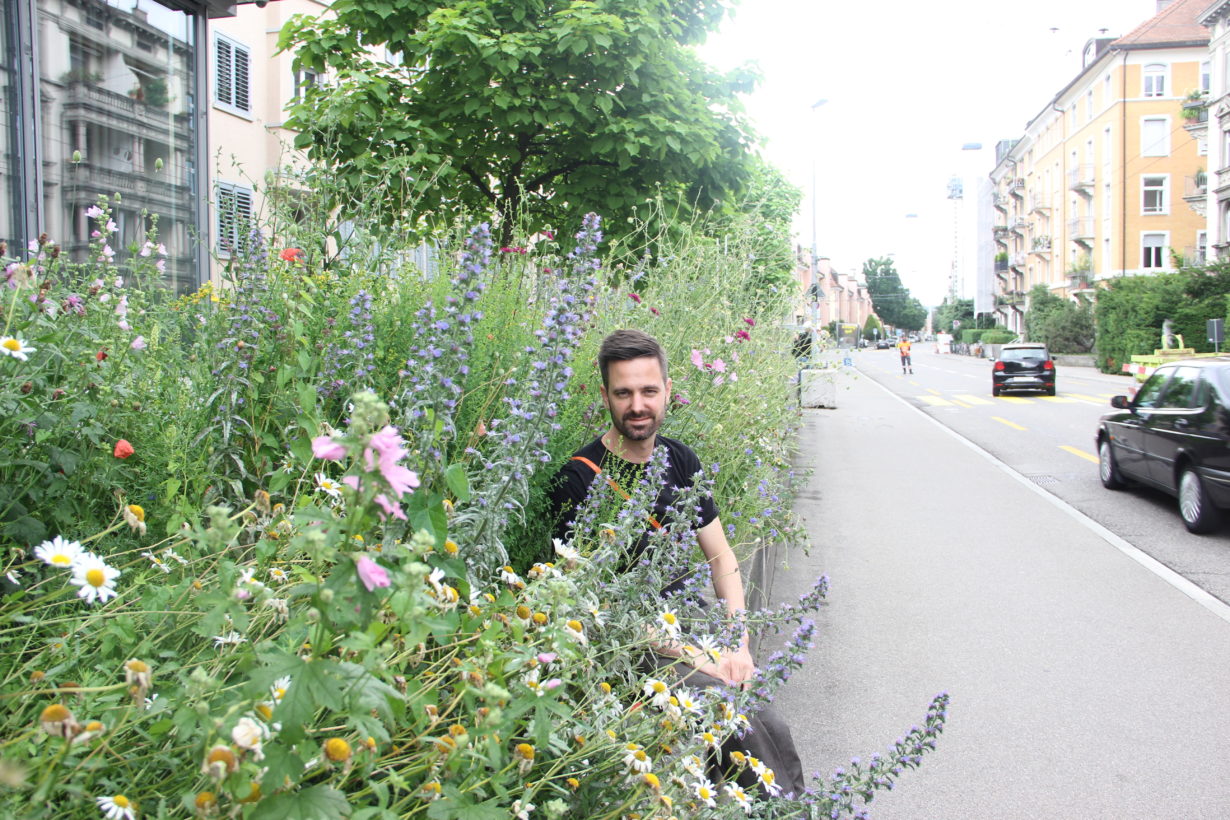
In the beginning, there was only a wild bee house from the Zurich Christmas market. But five years after his first BeeHome, Philipp Häcki's entire surroundings are flourishing. How the graphic designer with a green thumb brought wildflowers to the front gardens.
Some BeeHomes have a short fuse that ignites a fireworks display of good ideas. Philipp Häcki's BeeHome is one such case. The visual designer with a keen eye first saw a BeeHome at the Zurich Christmas market in 2015 – and had no idea that this wild bee house would indirectly create habitats for countless insects. Today, five years later, important pollinators in the Swiss metropolis benefit from his efforts: In front of and behind the properties of the housing cooperative Zürich 2, countless colorful wildflowers bloom next to the grey asphalt, and bees and bumblebees buzz busily from blossom to blossom.
BeeHome sparks a desire for more
For Philipp, his first BeeHome acts like a gateway drug into the world of wild bees and wildflowers. "As I stood on the balcony in the middle of winter, I wondered what food wild bees would need," Philipp recounts on his balcony in Zurich-Wollishofen. On the outer wall hangs the bulging BeeHome next to three other original nesting aids. What Philipp tackles, he does thoroughly. So, the father of two reads more and more about wild bees and their food sources. Even before the first rays of spring, the Buxus disappears from the balcony, making way for wild bee-friendly early bloomers like crocuses or wild fruit shrubs like the serviceberry. For the mason bees, which first swarmed around Philipp's BeeHome in spring 2016, it's the perfect start to the nesting season.
But that's not enough for the 40-year-old botany nerd. His entire surroundings are to bloom. He looks around his apartment on Mutschellenstrasse and has an idea. What if we create habitats with natural gardens on the outdoor areas of our cooperative? In 2018, he approaches the cooperative with this proposal, collects information about natural gardens, writes a concept, and designs convincing presentations. His topic: How to transform the outdoor areas of the properties into valuable habitats? In a first step, the residents are convinced of the project, then the concept is presented to the board. "The residents' reactions were mostly very positive, and the board immediately supported the project," reports Philipp, now an expert in natural gardens.
Sea of blossoms and play equipment
Several information events and meetings later, the project can start after two years. The cooperative fully approves the concept. Not only for one property on Mutschellenstrasse, but also for three other housing areas of the cooperative. In addition to the bees, the residents also benefit from Philipp's initiative. With the redesign of the outdoor areas, there are also new play equipment for children, barbecue areas, and raised beds. All of a sudden, the previously unadorned storage areas become popular meeting points.
The effort has paid off. "I am very satisfied," says Philipp, as he walks along the colorful sea of blossoms between the sidewalk and the lawn on Mutschellenstrasse. "We have created habitats here, promoted urban biodiversity, and also designed beautiful meeting places for the residents."
What a BeeHome at the Zurich Christmas market can trigger when it falls into the right hands.
About the person: Philipp Häcki lives with his two daughters (10 and 12 years old) and his wife in Zurich-Wollishofen. The graphic designer has always enjoyed collecting seeds on his hikes and walks and rewilding them in the city. With his natural garden project for the housing cooperative Zürich 2, he, as the initiator, ensured that life-friendly natural gardens now flourish on formerly monotonous green spaces.
About the project: After two years of preliminary planning and persuasive work, Philipp Häcki convinced the housing cooperative Zürich 2 to transform the outdoor areas of four properties into natural gardens. The maintenance of this total of 1200 square meters of habitat is carried out by specialized natural gardeners.
The project was supported by the "More than Green" project of Grün Stadt Zürich.