


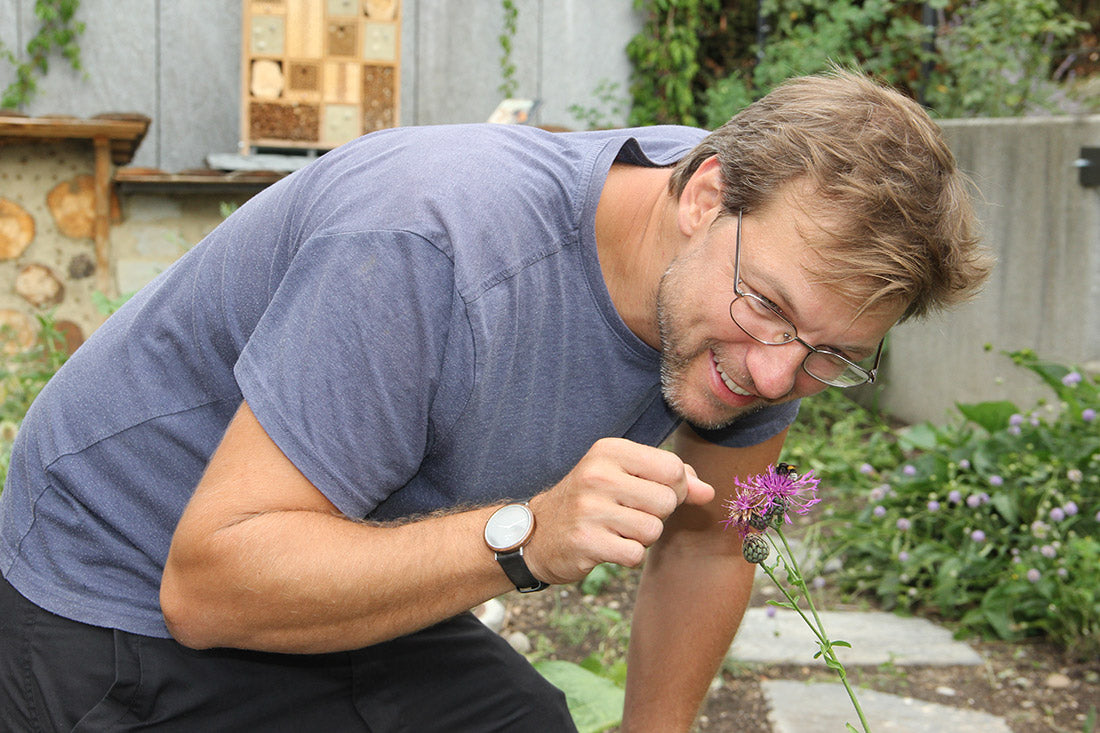
How endangered are wild bees really? And how can each individual promote these useful insects? Wild bee expert Dr. Claudio Sedivy, co-founder of Wildbiene + Partner, provides answers and tips that inspire a greater appreciation for nature.
Claudio, everyone is talking about insect extinction. Are there really so few insects, especially wild bees, left in Switzerland?
In fact, there is little scientific research on this question. However, the existing studies paint a very bleak picture. Why? It's not just that many once common species have become rare. Almost all species have declined sharply in number. There are indications that the total insect biomass in Switzerland has decreased by over 70 percent since the 1970s. Of the good 700 wild bee species in Central Europe, almost half are on the Red List of endangered species.
What role do wild bees play in the ecosystem? Why are they important?
As diverse and extremely efficient pollinators, wild bees play a key role in our ecosystem. They ensure that the countless native wild plants are pollinated, which then produce fruits and seeds to reproduce. Without wild bees, many wild plants would soon die out, leading to an enormous loss and severe impoverishment of biodiversity.
What threats do wild bees face?
Wild bees depend on diverse and natural habitats. A wide variety of native wildflowers provides the food source for wild bees. Many, sometimes rare species also thrive in settled areas under certain conditions.
However, these habitats are under severe pressure. In agricultural areas, pesticides are a threat to wild bees. Highly toxic insecticides such as neonicotinoids can kill wild bees even in the smallest doses. However, herbicides can be just as harmful. These destroy all "weeds" that should serve as a food source for local wild bee populations. An often underestimated problem, however, is also the increasingly fertilized and more frequently mown meadows. These are increasingly dominated by a few grass species, as these grasses benefit most from the excessive nutrient supply and displace flowering plants such as dandelions, cow parsley, buttercups, and daisies. The result is green, monotonous deserts that are useless for wild bees and many other insects.

Are wild bees also endangered in cities?
Yes, even in settled areas, where many wild bee species were able to retreat, they are coming under pressure. Garden owners often also spray various poisons, hoe and mill away "weeds" and plant exotic plants such as hydrangeas, forsythias, and geraniums. However, their flowers are worthless for wild bees. Important microstructures such as deadwood, open soil areas, and dry plant stalks are considered ugly and untidy and are rigorously combated. In short: poisons, over-fertilized meadows, cleared landscapes, and our urge to keep nature "in order" at all costs are the biggest threats to our wild bees.
What would a world without wild bees look like?
That's hard to say. In any case, there would be a completely impoverished plant diversity due to the lack of pollination. This in turn would have a catastrophic impact on the diversity of animals that ensure the ecological balance of nature. A mass extinction could follow with unpredictable consequences for humans and nature.
A direct consequence for us humans would be a massive collapse in agricultural output. 85 percent of the crops planted by humans are pollinated by bees. Honey bees only account for a small part of this. The disappearance of wild bees would therefore primarily result in a massive reduction in our diet.
How can wild bees be specifically promoted?
There are many possibilities here. The most important aids are these:
- Promote native wildflowers: A diverse and abundant presence of native wildflowers forms the nutritional basis for native wild bees. Lean and extensively used meadows and pastures, sparse and sunny forest edges, fallow land, but also natural gardens offer a diverse range of flowers and should be promoted and protected.
- Promote nesting sites: Wild bees use different nesting bases depending on the species to reproduce. Open, barren, and little-used soils are particularly important for the many rare ground-nesting species. Decaying wood and dry plant stalks are also extremely valuable nesting resources. Wild bee houses can also promote over twenty species and allow for wonderful observation.
- Do without all poisons: Whether insecticides or herbicides – chemical plant protection products should be avoided as much as possible. Today, there are biological and environmentally friendly alternatives for all applications of these chemical poisons.
- Protect natural areas: The protection and preservation of natural areas, which are settled by many wild bee species, is a particularly important and promising measure.

How effective is it to set up an insect hotel in the garden or on the balcony?
Many extremely exciting and beautiful wild bee species can be bred relatively easily on your own balcony in a wild bee house. The great thing about it: the wild bees can be observed wonderfully. Since wild bees do not sting and are not interested in food, humans and wild bees can live very well in direct proximity. For some species, wild bee houses offer an excellent substitute for natural nesting structures that have become rare, for example, dead trees.
Does promoting wild bees also help other insects?
Absolutely. Wild bees are excellent indicator organisms. This means: where there are many wild bee species, there is always a great diversity of plants and animals. Therefore, many plants, insects, and other animals automatically benefit from wild bee promotion.

About the person:
Animals and plants have always fascinated him. As a child, Claudio Sedivy, born in 1981, enjoyed catching newts, frogs, and dragonfly larvae from ponds in the middle of his hometown Zurich to study them closely. But most of all, the nature lover was impressed by the species richness of the plant world. Sedivy studied biology at ETH Zurich and completed his doctorate on wild bees there in 2012.
The botanist wants to know exactly how important these insects are for plants. In his research, Sedivy discovered the enormous pollination performance of mason bees in fruit growing and, after his doctorate, founded the company Wildbiene und Partner in Zurich. The concept: The company breeds mason bees, with which fruit growers improve their harvest through optimal pollination. In Germany, the subsidiary Pollinature GmbH pursues this proven concept.
But Claudio Sedivy is concerned with more than just agricultural benefits. That's why private individuals can buy BeeHomes, wild bee houses with mason bees. Sedivy: "People should find out for themselves how important certain insects are for us humans. The BeeHome brings this nature experience to the cities." His commitment to wild bees and plant diversity does not stop with his work for his company. On his days off, Sedivy goes to the mountains with a net to map the current wild bee population, gives lectures, creates wild bee paradises, and advises other companies. His goal: "Biodiversity should have the same importance as sustainability topics such as energy, construction, or water."