


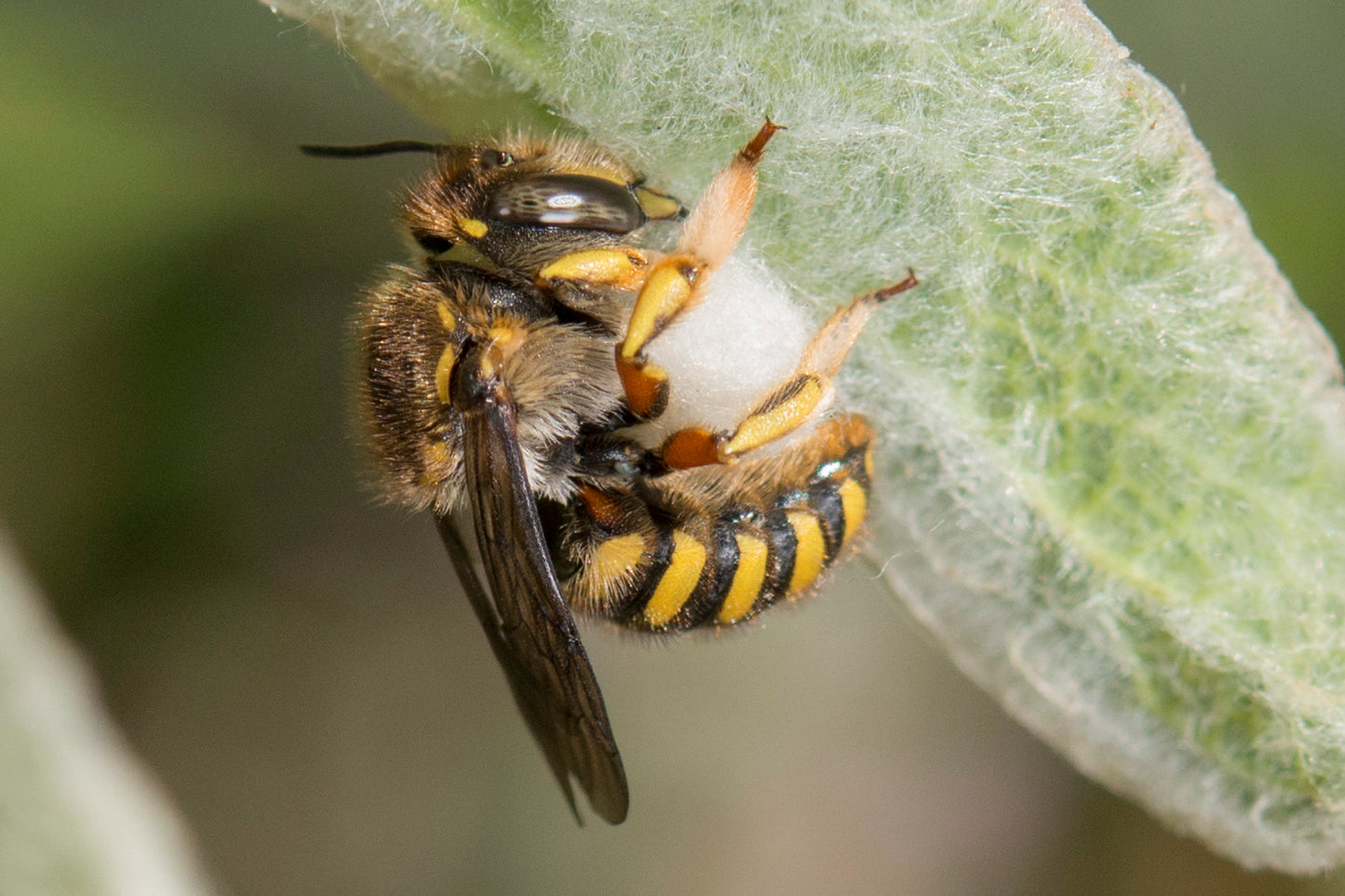
Wool carder bees are the exotics among wild bees: their offspring like it fluffy and soft. But when it comes to females, the males defend their territory fiercely.
Why are these wild bees called wool carder bees? It's because of how they build their nests. Wool carder bees lay their eggs on a kind of wool. However, this doesn't come from sheep, but from plants. More precisely, from the hairs that grow on many leaves.
These serve to protect the plants from insects, but are specifically harvested by wool carder bees. For this, wool carder bees only choose very hairy plants, such as lamb's ear or quince. These hairs are then brought into the nest and the pollen and egg are hidden inside (sometimes in combination with other materials such as earth or small stones). Since wool carder bees cannot always collect pollen and wool from the same plant species, they need several plant species to thrive.
This can certainly lead to injuries to other insects. Other male wool carder bees are grabbed in the air, and a kind of aerial wrestling match ensues. The males only give up once they have driven away the intruder. Only female wool carder bees are exempt from these attacks. Sometimes, several males may share a territory. But there is a clear hierarchy with a dominant male who is the only one allowed to mate with the females. The rest have to hope that the boss is occasionally distracted. This behavior is probably why male wool carder bees are larger than females. In most bee species, it's the other way around. A large, strong male simply wins more fights.
Wool carder bees are among the most spectacular wild bee species. Many are strikingly marked yellow-black or white-black and are therefore often mistaken for wasps. However, on closer inspection, it becomes clear that they are much more robust and plump than wasps, see the picture below.
Wool carder bees can be found on every continent (except Antarctica), with 92 species. In Europe, there are 15 Anthidium species, 6 of which are in Germany.
These animals have a high need for warmth even for bees and are only active at temperatures above 16°C. Therefore, they usually only fly out from late June to August. Compared to mason bees, for example, the genus is not very specialized and can collect pollen from a wide variety of plants. However, they do show certain preferences for legumes and mint-family plants.
If you want to observe wool carder bees at home, you need three things: suitable food plants, suitable plants as a source of wool, and nesting holes. The latter works well in a BeeHome. Since wool carder bees are quite large, they only accept the largest tubes.
Profile of the European Wool Carder Bee
Flight period: June–August
Size: Females 11–12 mm; Males 14–18 mm
Food plants: European wool carder bees can mainly be observed on mint-family plants and legumes. Less frequently, they also visit foxgloves and other plantains. Particularly popular are bird's-foot trefoil, sainfoin, lamb's ear, and motherwort.
Wool plants: Lamb's ear (Stachys byzantina), German woundwort (Stachys germanica), Silver wormwood (Artemisia latiloba), Quince
Overwintering: One or two generations depending on the year. Overwinters as a larva.