


Males cuddling together in a flower in the rain; wings that detach like Velcro? The world of wild bees is full of secrets. Here are some particularly curious cases:
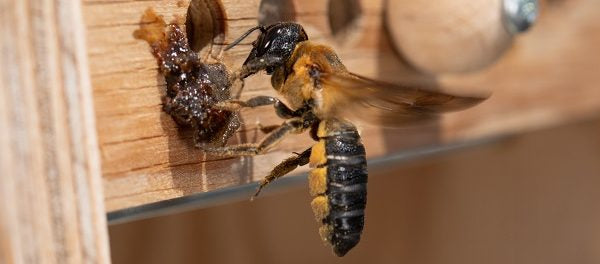
Dome Builders: The black mason bee (Megachile parietina) builds a separate dome for each egg using soil and small stones. This allows each young mason bee larva to grow in its own nursery. In the end, the industrious female covers all the nests with mortar, which she mixes herself from sand and saliva.
Temporary Mini-State: Several mated females of the yellow-banded furrow bee (Halictus scabiosae) temporarily form a breeding community in spring, after spending the winter in their natal nest. The largest female, acting as a kind of queen, lays eggs in the earthen nest in spring, while the other females collect pollen and nectar for the offspring. Before the queen's offspring hatch, she drives away her former workers. They then lay their own eggs, which they supply with their food reserves.
The Velcro Trick: Although it's hard to see: wild bees have two wings on each side, left and right. When flying, the forewing is firmly connected to the hindwing by a row of hooks, similar to Velcro. When landing, the bee can decouple the wing pairs.
Hairless Pollen Swallows: Not all wild bees transport pollen externally on their bodies. Masked bees (Hylaeus) have no body hair and therefore swallow pollen for their offspring. In the nest, they regurgitate it along with the sucked-up nectar.
Flower Cuddlers and Stem Biters: On a rainy spring or summer day, take a close look at bellflowers or mallows. You might find wild bees sleeping there, huddled together for protection within the petals. Other sleeping places are not so easy to discover, as some wild bee specimens rest in very special ways. At night and in the rain, they bite onto blades of grass or thin twigs and rest in this position, sometimes even upside down.
Love Scents: Wild bee males are also guided by scents for mating. For example, freshly hatched, unmated female mason bees emit a captivating aroma. Several males often rush to these females to participate in the approximately two-hour mating process. Mated females change their scent so that they are no longer harassed by ardent males and can take care of their offspring.
A Snail Shell as a Nursery: Most wild bee species nest in the ground or in easily accessible cavities. Some mason bee species, however, lay their eggs in very special cavities: empty snail shells. In doing so, these species make an effort that is perhaps unique in the insect world. The two-coloured snail shell mason bee (Osmia bicolor), for example, takes a whole day to provision a single egg with pollen, seal the nest, and carefully camouflage the snail shell.
Rude Bees: Wild bees are almost always very peaceful. Only when it comes to mating do the male specimens sometimes get rough. This can be particularly well observed with mason bees at the BeeHome when the first females appear. A fierce battle immediately erupts between the males, which only one always wins. Wool carder bees are even more aggressive, especially the European wool carder bee (Anthidium manicatum). Each male seeks out a flower-rich territory, which it defends against all flying insects: honey bees, other wool carder bee males, even against bumblebees. If threats are not enough, the wool carder bee rams the flying intruder with its thorns on its abdomen. The flower territory is meant to remain attractive for a very specific group: Only female wool carder bees are allowed in to collect pollen. Then the male has reached its goal and mates with the female.
Designer Babies: Boy or girl? What humans can't easily choose for their babies is completely normal for wild bees. Female mason bees, for example, can determine the sex of their offspring themselves: fertilized eggs become females, unfertilized eggs become males. This is practical for the hatching order. In the nesting tubes, the mothers always lay unfertilized eggs at the front, because the males hatch earlier, clearing the way for the females. They crawl out of their cocoons a few days after the males.
Oil Instead of Pollen: Most wild bee species collect pollen and nectar for their offspring. This is different for the European yellow-loosestrife bee (Macropis europaea). It needs oil instead of nectar for its offspring. Therefore, on its flights, it searches for plant oil, which it mainly finds on loosestrife species. It mixes the oil with pollen to form an oil cake, which is particularly energy-rich. However, even the European yellow-loosestrife bee cannot do without nectar entirely. It needs it as fuel for its strenuous flower flights and also uses it to line the nesting chamber.
Exciting, isn't it? If you're now keen to experience wild bees up close yourself, take a look at our BeeHome Shop .
{formbuilder:NDMyOA==}