


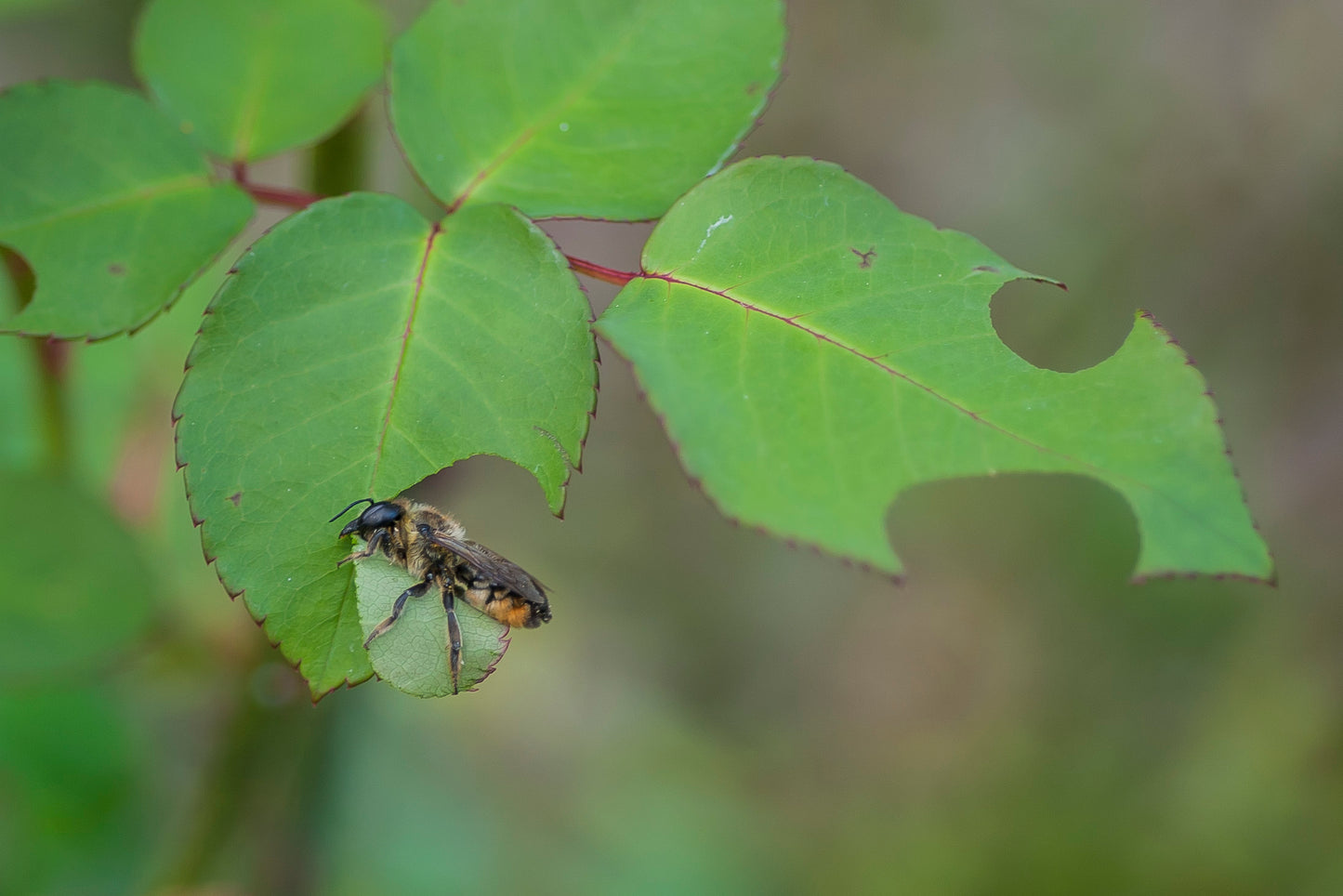
Leafcutter bees are one of the most striking genera of wild bees you can discover in your BeeHome. This is due to their extraordinary nesting material: they fly to their nest riding on it like on a saddle.
As the name suggests, leafcutter bees build their nests from leaves. Anyone who sees one of these wild bees fly past for the first time with a bitten-off piece of leaf will rub their eyes in amazement: it looks as if a bee is riding through the air on a green saddle. Although many Megachile species use leaves as building material, this is not true for all species. Hence the strange name leafcutter and mason bees. This is because some species use a mortar made of sand and clay for nest building.
Nesting material grows on trees
Leafcutter bees: These bees use pieces of leaves as building material, with which they completely line the brood cells. The larvae are completely encased in leaves. The entrance to the nest is also sealed with a thick plug of leaf material.
Preferred nesting material includes hard leaves from maple, beech, rose, or hornbeam. These are meticulously cut out in a complex process. The bees cut simultaneously with their mandibles and roll up the leaf with their legs. This work is apparently so strenuous that the bees have to take a few minutes' break on the leaf afterwards. The piece of leaf is then brought into the nest. Depending on the species, this nest can be in a BeeHome, but also in rotten wood, under stones, or in the ground.

This is what happens to the leaf pieces in the nesting tubes: The leafcutter bees use them to build their nurseries.
Mason bees: They don't use leaves, but sand, which they mix into a mortar. Some species, like the Lathyrus mason bee (Megachile ericetorum), use it to line the reed tubes in their BeeHome. Others build free-standing nests on facades or large stones, such as the rather rare Black mason bee (Megachile parietina). Resin is also used as a building material. The Lathyrus mason bee uses it to line the inner walls of its brood cells.
The largest species has a 6-centimeter wingspan
The genus of leafcutter and mason bees is quite large with 1500 species and can be found on all continents – including the largest bee in the world, which lives in Indonesia: Megachile pluto (Wallace’s Giant Bee) with a wingspan of over 6 centimeters. In Europe, there are at least 75 Megachile species, of which 23 or more are in Germany.
Many Megachile species also occur in settled areas and are happy to move into a BeeHome. Most are not very specialized and therefore find food for their offspring almost everywhere. Nevertheless, they have preferences: The garden leafcutter bee, for example, collects pollen mainly from legumes, composites, succulents, and bellflowers.
These species like to move into a BeeHome
Lathyrus Mason Bee (Megachile ericetorum)
The Lathyrus mason bee is a very industrious builder, using large quantities of clay and sand in its nests. The individual brood cells are often barely distinguishable, as the entire nest consists of a continuous clay tube. The inside of each brood chamber is additionally lined with a layer of resin. They can be regularly observed in BeeHomes. Their favorite plants are legumes. This plant group also includes cultivated plants such as peas or various bean species. With a small vegetable garden (and a few other plants), these animals might also be attracted to your BeeHome.

- Flight period: Mid-June to end of July
- Size: 13-15 millimeters
- Food plants: Specialized in legumes such as lupine, peas, common bird's-foot trefoil, and Lathyrus species
- Overwintering: One generation per year, overwinters as a larva.
Alfalfa Leafcutter Bee (Megachile rotundata)
A widespread leafcutter bee that was introduced to the USA from Europe a long time ago. There, the alfalfa leafcutter bee is the most important pollinator for the production of alfalfa seeds. In Europe, however, it is not used for this purpose. It is a widespread bee that also likes to move into BeeHomes. There, it prefers tubes with a diameter of around 6 millimeters.

- Flight period: End of June to mid-August
- Size: 8-9 millimeters
- Food plants: Alfalfa, white clover, common bird's-foot trefoil, round-headed garlic, and many other plants
- Overwintering: One generation per year, probably overwinters as a larva.

Small Garden Leafcutter Bee (Megachile centuncularis)
The Small Garden Leafcutter Bee is not very common, but can occasionally be found in a BeeHome.
A smaller leafcutter bee, generally somewhat inconspicuous. It is often found in settled areas, but never in large numbers, and you need a bit of luck to observe it. It is not picky about its food plants and accepts many species as nourishment.
- Flight period: Early June to early September, the second generation sometimes until October
- Size: 11-12 millimeters
- Food plants: Not very picky, golden thistles, knapweed, chicory, but also bird's-foot trefoil or wood pea and many others
- Overwintering: Sometimes two generations per year, probably overwinters as a larva.
Asian Mason Bee (Megachile sculpturalis)
As the name suggests, the Asian Mason Bee is not native to Europe and was first observed in the Marseille area in 2008. How it exactly came to Europe is unclear. Since then, however, it has spread far north and can also be found in Switzerland and Southern Germany. This species is now quite common, but unfortunately has the unpleasant characteristic of plundering the nests of other wild bees and solitary wasps. The bees build their nests from resin; the closure is made of earth and can at first glance be mistaken for mason bee nests. The nests smell strongly of resin and are very noticeable in the BeeHome Observer drawer, as the nest is filled with a brown-black mass.
- Flight period: July to September
- Size: 13-25 millimeters
- Food plants: Ligustrum, sweet chestnut, Japanese pagoda tree
- Overwintering: One generation per year, probably overwinters as a larva.

Do you also want to observe leafcutter and mason bees at home? With the right plants and a BeeHome, you might be able to attract these fascinating wild bees.