


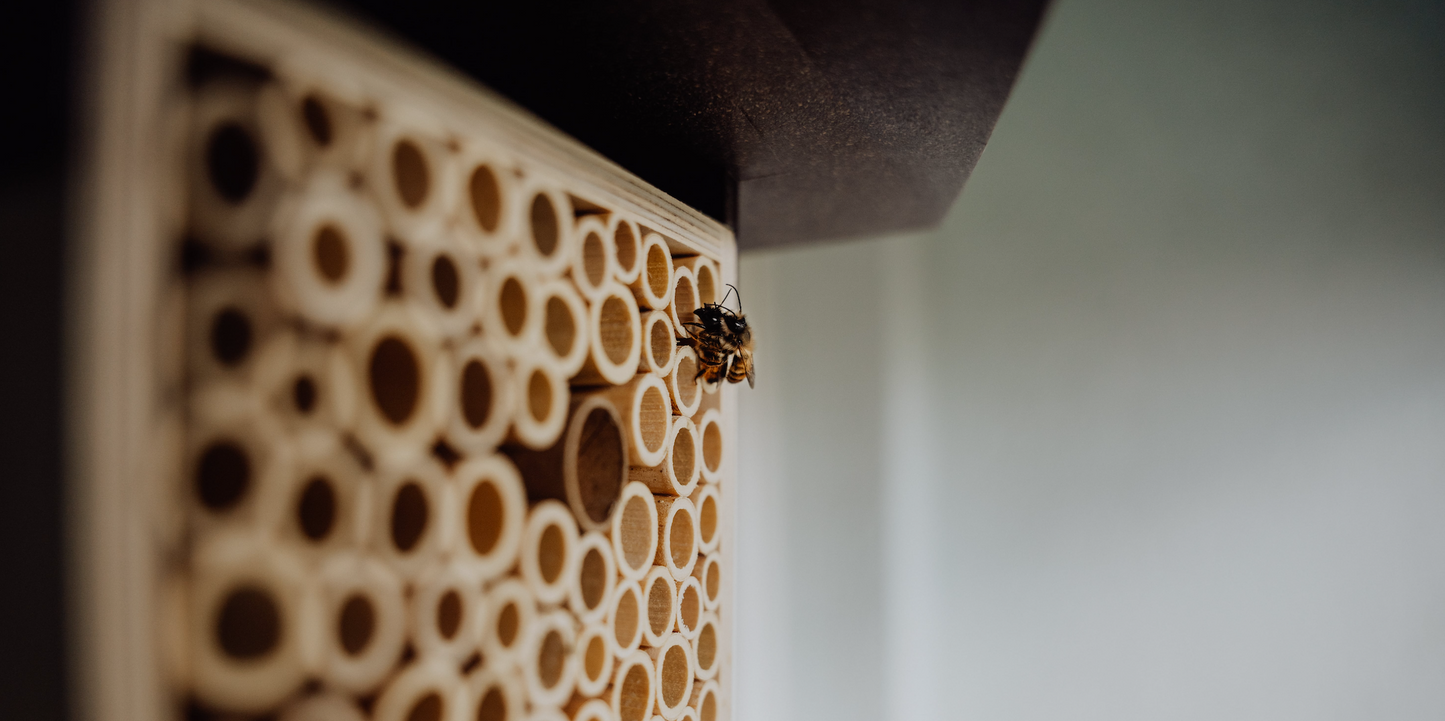
Wild bees have specific requirements for nesting aids. The type of wood, the type of drilling, and the condition of the nesting entrance are crucial for the well-being of cavity-nesting wild bees. These are the five most important points to consider before purchasing a wild bee nesting aid:
1. The material of the nesting tunnels:
The material used must be waterproof and thick to limit the reproduction

of parasites in the nesting tubes. For our BeeHomes, we use giant reed (bot. Arundo donax), also known as Spanish reed. We chose this reed for its diameter and durability. Unlike common reeds, the thickness of Spanish reed helps limit the spread of parasites and parasitic wasps between nests and protects the offspring.
2. The hole diameter: Each wild bee species prefers specific cavities. Pay attention to the length of the nesting tubes and the number of species that nest in tubes of that diameter. Our tubes have a diameter between 5 and 11 millimeters and perfectly suit the needs of mason bees, which we provide with our wild bee nesting aid. The BeeHome can also house around 20 other species, such as the Steel-blue Mason Bee.
3. The cutting of the tubes: The tunnel floor must be closed so that the wild bee feels safe. Ideally, each tunnel should have a node, the natural partition in reed tubes. That's why we ensure that every nesting tube in our BeeHome has such a node by cutting them individually by hand. The nesting tubes must also not be too short. In the BeeHome, our cuts, which are more than 13 centimeters long, have proven effective.
4. The nature of the entrances: Wild bees prefer smooth

nesting entrances that they can crawl into and out of without risk of injury. They ignore splintered and fibrous tubes. For this reason, all our reed tubes for the BeeHomes are carefully sanded. In addition, we do not use glue to attach the tubes, so as not to deter the wild bees with its scent.
5. Protection against moisture: Many nesting aids are made from unsuitable coniferous wood. In this wood, small cracks appear in the holes, moisture penetrates, and fungal infestation threatens the brood. A roof with a generous overhang offers additional protection against moisture. We use pine plywood from sustainable forestry, certified with the PEFC seal. The roof is made of bio-based plastic.
Often enough, the houses offered on the market for a few francs per piece are manufactured in China. To be able to offer such a low price, the working conditions are questionable, and the materials used are not certified. These products are then shipped all over the world, leaving a considerable ecological footprint. As a counter-proposal, we have the BeeHomes manufactured in social workshops in Switzerland.
Discover the high-quality BeeHomes.
