


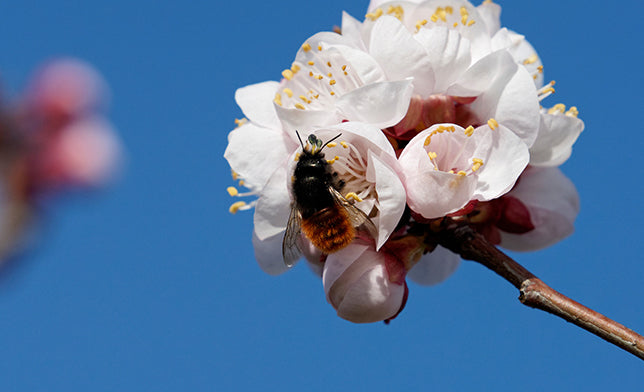
Why are mason bees so popular with fruit growers? And why do the males always emerge before the females? 10 interesting facts about the master pollinators among wild bees.
1: The highly adaptable Red Mason Bee (Osmia bicornis) is widespread across large parts of Europe. It can be found from cool southern Sweden to hot North Africa.
 2: Newly emerged males usually have to wait impatiently for a few days until the first females appear. Mating lasts up to two hours, and immediately afterwards, the females begin nesting.
3: Mason bees are not picky when it comes to choosing a nesting site. If they can't find anything better outside, they will even lay their eggs in spools of yarn, wall plugs, or roller shutter stoppers. Nests have even been found in old exhaust pipes.
4: To create a brood cell with an egg, a collected supply of pollen-nectar, and clay partition walls, a female needs several hours.
5: Mason bees do not lay eggs in the frontmost brood cell of a nesting tube. This trick is meant to deter hungry birds from preying on cocoons with their beaks.
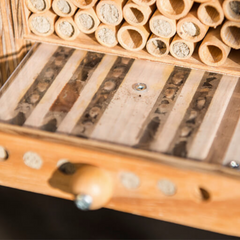
6: Mason bees can determine whether an egg laid will be male or female. Females develop from fertilized eggs, and males from unfertilized eggs. Because males emerge two to three days before females, mason bees lay male eggs in the front brood cells. This allows the females to exit freely.
7: The parents never see their bee offspring. This is because mason bees die after nesting in the summer, long before their offspring emerge from their cocoons the following spring.
8: Horned mason bees and red mason bees are excellent pollinators because they collect dry pollen in their abdominal scopa. 98 percent of their flower visits result in pollination. Honey bees, which transport pollen mixed with nectar on their legs, in contrast, have to visit an average of 7 apple blossoms to pollinate a single one.
9: The females of the Red Mason Bee have two horns on their heads. This is why the scientific name includes bicornis = two-horned.
The annual pollination service by insects, including honey bees and wild bees in Germany, is estimated at 1.3 billion Euros. In Switzerland, it is approximately 350 million Swiss Francs.
The annual pollination service by insects, including honey bees and wild bees in Germany, is estimated at 1.3 billion Euros. In Switzerland, it is approximately 350 million Swiss Francs.
10: Mason bees can determine whether an egg laid will be male or female. Females develop from fertilized eggs, and males from unfertilized eggs. Because males emerge two to three days before females, mason bees lay male eggs in the front brood cells. This allows the females to exit freely.