


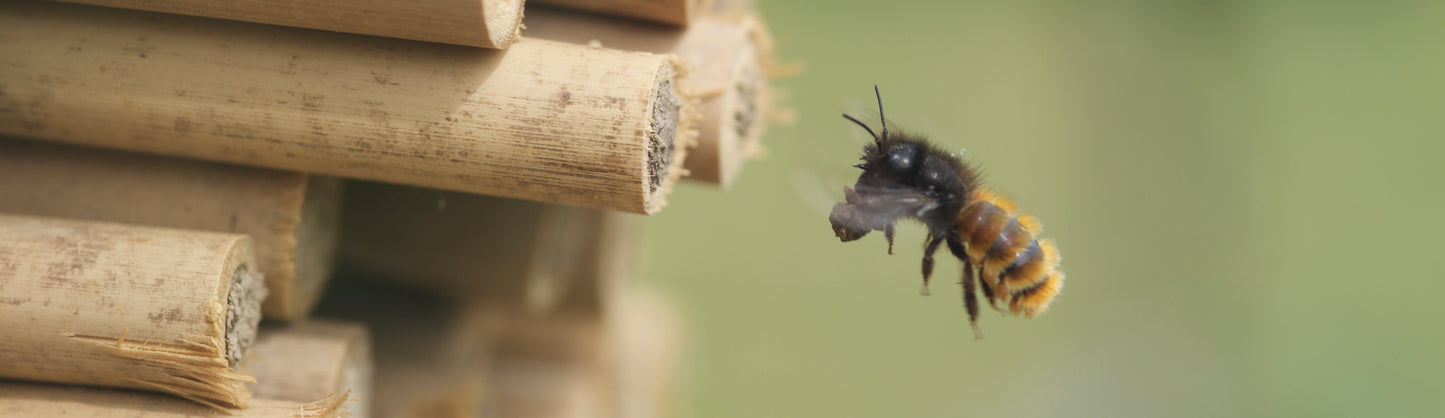
Did you know where mason bees get their name? And that some species choose very special nurseries for their offspring?
As a BeeHome owner, you've probably heard the name mason bee or Osmia before. You've almost certainly seen one of the many mason bee species, the widespread red mason bee, also simply called red mason bee (Osmia bicornis). After all, these industrious insects populate your BeeHome. But there are many more mason bees, as mason bees are not a single species, but a genus (a genus is a group of closely related species). Mason bees are found in the temperate zones of Europe, Asia, and North America. There are 101 species of mason bees in Europe.
The German name Mauerbiene (mason bee) comes from the fact that these animals seal their nests with small walls, mostly made of clay or chewed plant material. Some mason bees also use sand or small stones. But not all species work this way. With so many species, there are always some that need to set themselves apart from the others: Mason bees inhabit many different habitats and have different requirements for nesting sites. They build their nests in existing cavities, in sandy soils, in self-dug tunnels in dead wood, or even in empty snail shells, as the snail shell mason bee does. If you'd like to observe their extraordinary nesting method yourself, we have some exciting video footage with practical tips here. Unfortunately, it's not so easy to attract snail shell mason bees, as they don't occur everywhere. But why not scatter a few empty snail shells in your garden; you might get lucky.
Mason bees are sought-after pollinators
Mason bees play a major role in agriculture because, alongside honeybees and bumblebees, they are the most important pollinators of our fruit and berry plants, at least in the Northern Hemisphere. They don't occur in the south. Mason bees are among the first species to become active in the year (February!) and among the last species you can observe in the year.
Some species are quite specialized, so they are only found very scattered and not in large numbers. Other species are common and feel very comfortable in human settlements. Like the red mason bee in your BeeHome. If you want to attract more mason bees to your home: no problem! The BeeHome is an ideal shelter for many species. Provide the right food plants and you'll soon have new residents for the summer.
These mason bee species also like to nest in the BeeHome
European orchard bee (Osmia cornuta)

The European orchard bee is an excellent pollinator. You've probably seen this species before and perhaps mistaken it for a small bumblebee. Alongside the red mason bee, it is the most common species in your BeeHome. It flies much earlier than the red mason bee (sometimes as early as February) and is noticeable for its orange-red abdomen.
Flight period: March to May (sometimes as early as February)
Size: 10-15 mm
Food plants: Willows, blackthorn, fruit trees, maple

Wallflower mason bee (Osmia brevicornis)
Their children grow up in a kind of shared living space: wallflower mason bee on a night-scented stock. The females of this species are easily recognizable by their iridescent blue body and rusty-red scopa. The males are much more inconspicuous. The wallflower mason bee is a somewhat rare guest in a BeeHome but has interesting breeding behavior. It does not build walls between the individual brood cells, and the larvae feed together from a common pollen supply in a kind of large shared living space. This distinguishes it from the other mason bees in this list, each of whose larvae occupies its own cell.
Flight period: April to June
Size: 8-11 mm
Food plants: mainly wallflower species, rapeseed, wild mustard

Thistle mason bee (Osmia leaiana)
Thistle mason bees can be observed until the end of August. With thistles nearby, they might also settle in your BeeHome. This mason bee is one of the last species you can observe at your BeeHome in the year. It loves thistles. Even if these plants have a bad reputation: Give thistles a chance. They are not only a valuable plant for Osmia leaiana but also for other insects. And some thistles also look impressive, for example, the cotton thistle.
Flight period: May to end of August
Size: 8-10 mm
Food plants: Thistles and knapweeds