


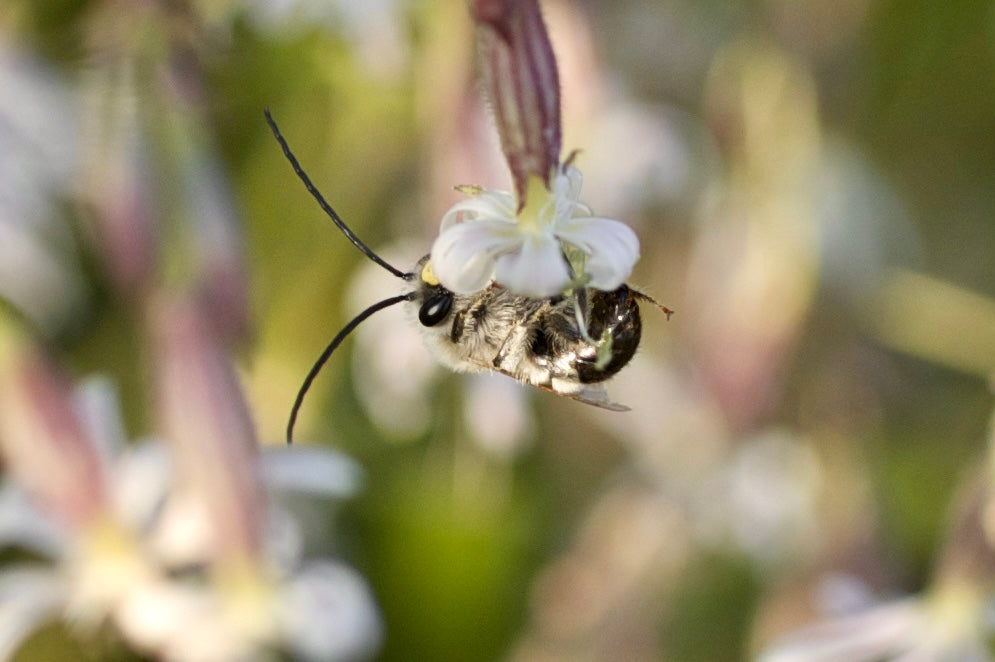
It is small and humble, yet indispensable for nature and us humans: the bee. This important insect is therefore honored on May 20th with World Bee Day. At Wildbiene + Partner, however, the busy pollinators are already in focus all year round.
By Kirsten Astor
The calendar is full of crazy commemorative days. There’s Sweatpants Day, Puddle Jumping Day, Change Your Password Day, and Seed Swap Day. Yes, there’s even an official World Toilet Day. While some of these action days are more humorous, World Bee Day on May 20th has a serious background. It’s about nothing less than biodiversity and food for the whole world.
After all, due to their indispensable pollination services, bees contribute to biological diversity and to food security for humans and animals. In addition to honey bees, there are about 20,000 wild bee species worldwide, over 600 of them in Switzerland alone. All of them perform at their best every day, although they actually only want to provide for their offspring: While wild bees fly out immediately after hatching and mating to strengthen themselves with nectar and look for tasty pollen provisions for their larvae, they fly from blossom to blossom. The colorful pollen sticks to their legs or belly and is brushed off there when they rest on the next blossom – and just like that, this blossom is also pollinated, and seeds and fruits can form. Without this diligent work of the bees, about a third of our food could not thrive.

We at Wildbiene + Partner recognized almost ten years ago the significant role bees play in our ecosystem
Our goal is therefore to contribute to halting the decline of bee populations through well-founded educational work, targeted wild bee breeding, and the creation of wild bee paradises. On the one hand, we help fruit growers naturally increase their yields by letting our wild bees buzz in their plantations. This is because they are not as sensitive as honey bees: Mason bees, for example, fly even in low temperatures and bad weather and pollinate many more fruit varieties than honey bees. On the other hand, we also want to share our enthusiasm with everyone who has little to do with biodiversity or bees so far. Everyone, whether in the city or in the countryside, can contribute to the propagation of these useful animals.
BeeHome as the perfect start to a nature experience
With our wild bee house BeeHome, interested individuals can breed wild bees at home and thus contribute to sustainable pollination in their surroundings. Not much is needed for this: a sheltered, sunny spot in the garden, on the terrace, or balcony, a BeeHome, and a starting population of 25 mason bee cocoons, which are delivered free of charge in spring – and the bee adventure can begin. Anyone who wants to give the pollinators a head start and thus a livelihood can sow a few insect-friendly flower seeds. Dragonflies and butterflies will also be happy about this.

And don't worry: wild bees are neither interested in food or drinks nor do they sting. The animals simply go about their work and can be observed from close up – which is also great fun for children.
More and more people are catching our enthusiasm
Our growing community in Switzerland and Germany currently consists of 172,000 members, in whose BeeHomes over one million red mason bees hatched last year alone. In 2021, these bees pollinated over 1.5 million flowers. Impressive, isn't it?
Visit us at the "Unser Klima" fair!
If you want to learn more about us, feel free to visit here. We will also be available for personal discussions from May 19th to 21st at the "Unser Klima" fair at Zurich Main Station (free entry). Our Wild Bee Whisperer Yannick Schauwecker will be giving a keynote speech on World Bee Day from 12:00 PM to 12:15 PM and will be happy to give interviews. We look forward to your visit, and those who come on May 20th can look forward to a small surprise!
