


Who doesn't know the famous children's song "Summ, summ, summ – Bienchen, summ herum" (Buzz, buzz, buzz – little bee, buzz around)? Currently, there is indeed a buzzing and humming sound from the many colorful blossoms in gardens and spring meadows. But for the next generation of busy bees to grow, the animals need an ideal shelter. Our sustainably produced BeeHome focuses on quality – and that pays off, as our author has observed on her balcony for a few weeks now.
By Kirsten Astor
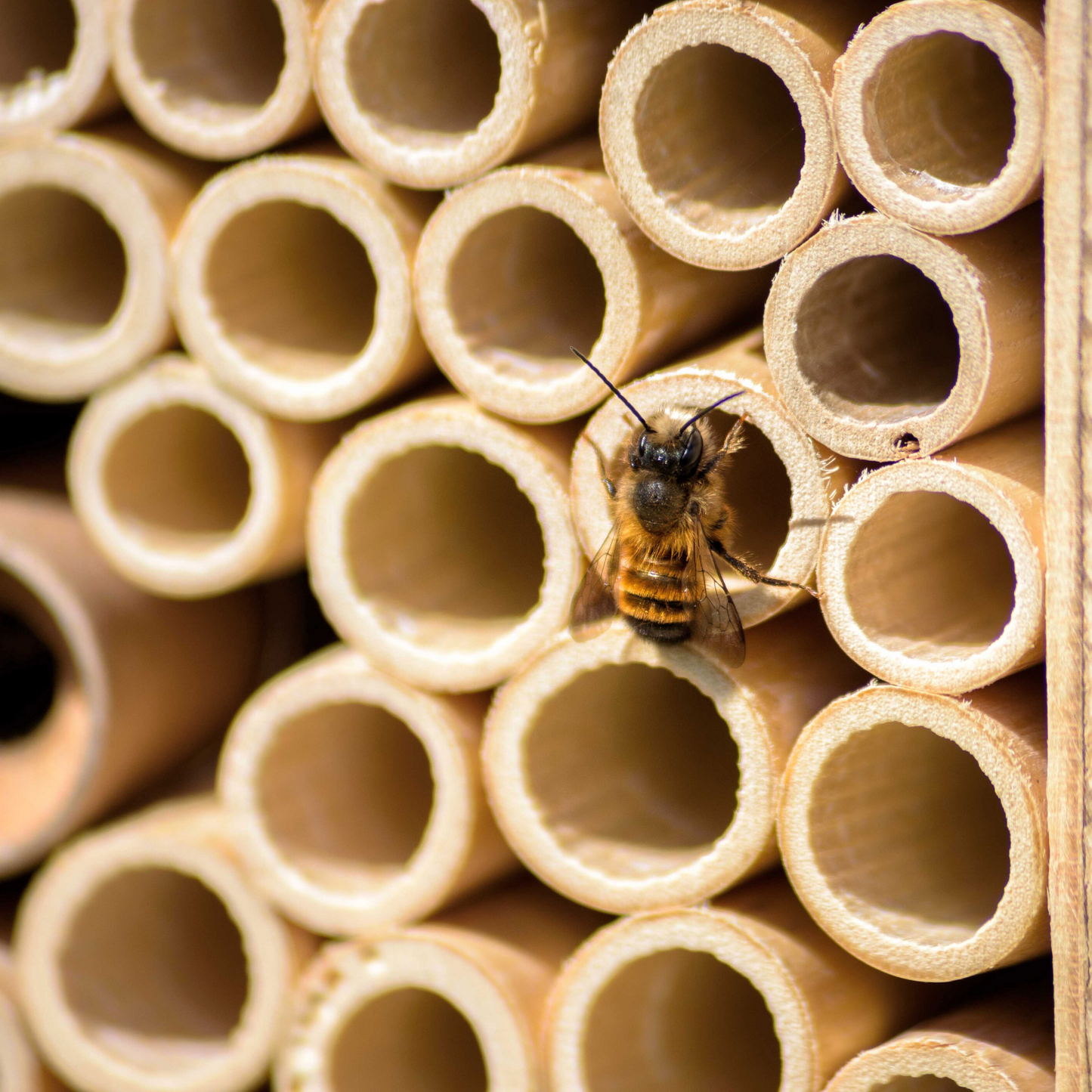
The air traffic outside my window is incredible. With the balcony door open, the buzzing is clearly audible: again and again, small, velvety-soft mason bees glide towards our BeeHome, hesitate briefly, and then crawl into one of the many wooden tubes. After a while, they come out again and fly away, only to return a little later and continue building their work. Their abdomen is yellow, full of valuable pollen, which they provide to their larvae in their cozy quarters. In the meantime, many nesting tubes in the BeeHome are full of tiny and transparent shimmering bee larvae, each provided with a pile of pollen for a good start in life – next spring.

What to look out for
If your (self-built) insect hotel is not really in demand, there can be many  reasons for it: the wrong material for the nesting tubes, for example, or too sharp entrances that injure the bees. Perhaps a well-intentioned colorful coat of paint also smells too toxic. However, anyone who hangs up a BeeHome can be sure of a good rating from the bees. They recommend it to their conspecifics, so that every year even more pollinators gather at the house. The recipe for success has several components: On the one hand, Wildbiene + Partner uses giant reed (Arundo donax), also known as Spanish reed, for the nesting tubes. Its thickness and resistance prevent the spread of parasites between the nests, thus protecting the offspring.
No glue is used
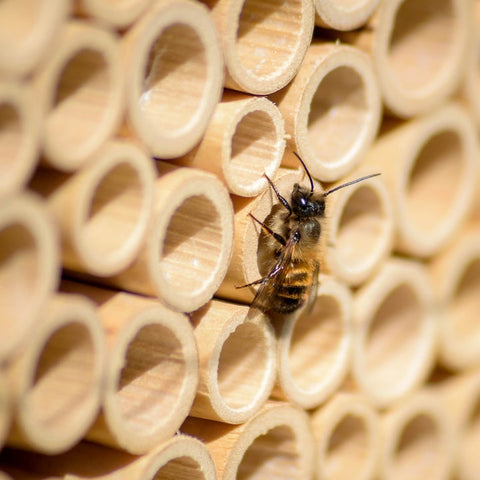 5 and 11 millimeters are ideal for the red mason bee. It is also important that the bees do not hurt themselves when crawling in and out. For this reason, all reed tubes for the BeeHomes are carefully sanded. In addition, no glue is used to fasten the tubes, so as not to deter the wild bees with its smell. And the pollinators literally have a roof over their heads – made of bio-based plastic and with a wide overhang so that no moisture can get into the nesting tubes.
 Each BeeHome is unique and is produced by hand. Only after a strict quality control is a bee house allowed to leave the wood workshop, well and plastic-free packed, to offer a new home to the important pollinators. Martin Ruetz, CEO of Wildbiene + Partner, considers another aspect important: "Our BeeHomes are carefully manufactured by social, local facilities," he says. BeeHomes are not cheaply produced in the Far East to then travel long distances, but exclusively made in Switzerland by wood specialists and in social workshops.
Red carpet for the bees
The buzzing insects are thus metaphorically given the red carpet. Because we humans appreciate the work of bees. Their foraging for their offspring, during which they fly from blossom to blossom and pollinate them, is vital for us. "A third of our food depends on pollination," says Martin  Ruetz. "It's alarming that 75 percent of all insects no longer exist. It's about counteracting the resulting imbalance in nature with targeted propagation and raising public awareness. The numbers speak for themselves. Everyone can do something."
Anyone who hangs up a BeeHome and ideally sows bee-friendly wildflowers nearby not only contributes to biodiversity but can also combine the benefit with a lot of fun. "The guaranteed experience with hatching, harmless mason bees is fascinating," enthuses Ruetz. "I often sit next to it to watch the buzzing and nesting. It naturally has a calming effect on me." That's why he enjoys working for Wildbiene + Partner so much: "I combine entrepreneurship with meaningful work. We hope to inspire many people to contribute to a future with wild bees. Will you join us?"
