


We are overexploiting our planet at an alarming rate. The "planetary boundaries" model, developed by scientists worldwide, clearly shows which sectors we are overstretching our world in. Where does climate change, which seems to dominate everything, fit into this?
Guest article from Netzwerk Blühende Landschaft:
The equally surprising and striking news: Climate change is not the biggest problem. Instead, land-use change, the over-fertilization of land and water, and, most prominently, the loss of biodiversity rank before it.
Climate change, material flows, land use, and biodiversity influence each other. Yet, for far too long, these factors have been considered separately in science. Meanwhile, there is a broad consensus among scientists of the World Biodiversity Council IPBES and the World Climate Council IPCC that these challenges must be viewed as a unit. The logical conclusion: Solutions must also be holistic and integrative.
The Three Dimensions of Biodiversity
The close relationship between biodiversity and climate change becomes particularly clear when one examines the three dimensions of biodiversity itself: In addition to species diversity, the diversity of habitats (in which species live) and genetic diversity (including the diversity within species) also contribute to the richness of life.

Each of these three aspects has its own interactions with the climate and its change:
- Habitats are altered by a different climate: higher temperatures dry out wetlands, more frequent and prolonged heavy rainfall events flood dry sites, forests burn. Ultimately, many habitats are altered or completely lost.
- Today, climate changes occur many times faster due to human activity. The alteration of habitats means that animals and plants that were perfectly adapted up until now can no longer cope in their habitats.
They literally cannot keep up, neither in their genetic adaptation nor in their mobility. We are losing biodiversity. - While species diversity and habitat diversity are primarily threatened or at least altered by climate change, genetic diversity holds enormous potential for adaptability to change. Within a plant species, for example, there are many different types: Daisies growing on sandy soils on the Baltic Sea form a different regional plant community than daisies on the Rhine, and yet another than daisies at the edge of the Alps. If environmental conditions change – for example, due to climate change – then this genetic diversity provides a buffer: With great diversity, the chances are higher that a genetic combination exists that is suitable for the altered environmental conditions and thus ensures the survival of the species and its function in the ecosystems.
The diversity of life creates stability – a stability that we urgently need in times of accelerated global change.
Considering Climate
What is striking about all these challenges: land use, plant nutrients, and biodiversity all have to do with the landscape. This is not least why climate change is also increasingly found in the work of the Netzwerk Blühende Landschaft. We, too, cannot think of biodiversity without climate, or vice versa. What would happen if, in our projects and consulting, we relied on cheaply propagated uniform seed from a few origins? We would spread mass quantities of seeds from genetically very similar plants, create a genetic bottleneck, and thus flatten the genetic diversity of the plant species. In other words: we would reduce genetic diversity in favor of species diversity – adaptation potential goodbye. Therefore, the topic of regional seed has always been of central importance to us, also to preserve and promote the regional and genetic diversity of plants, not least as adaptation potential for climate change.
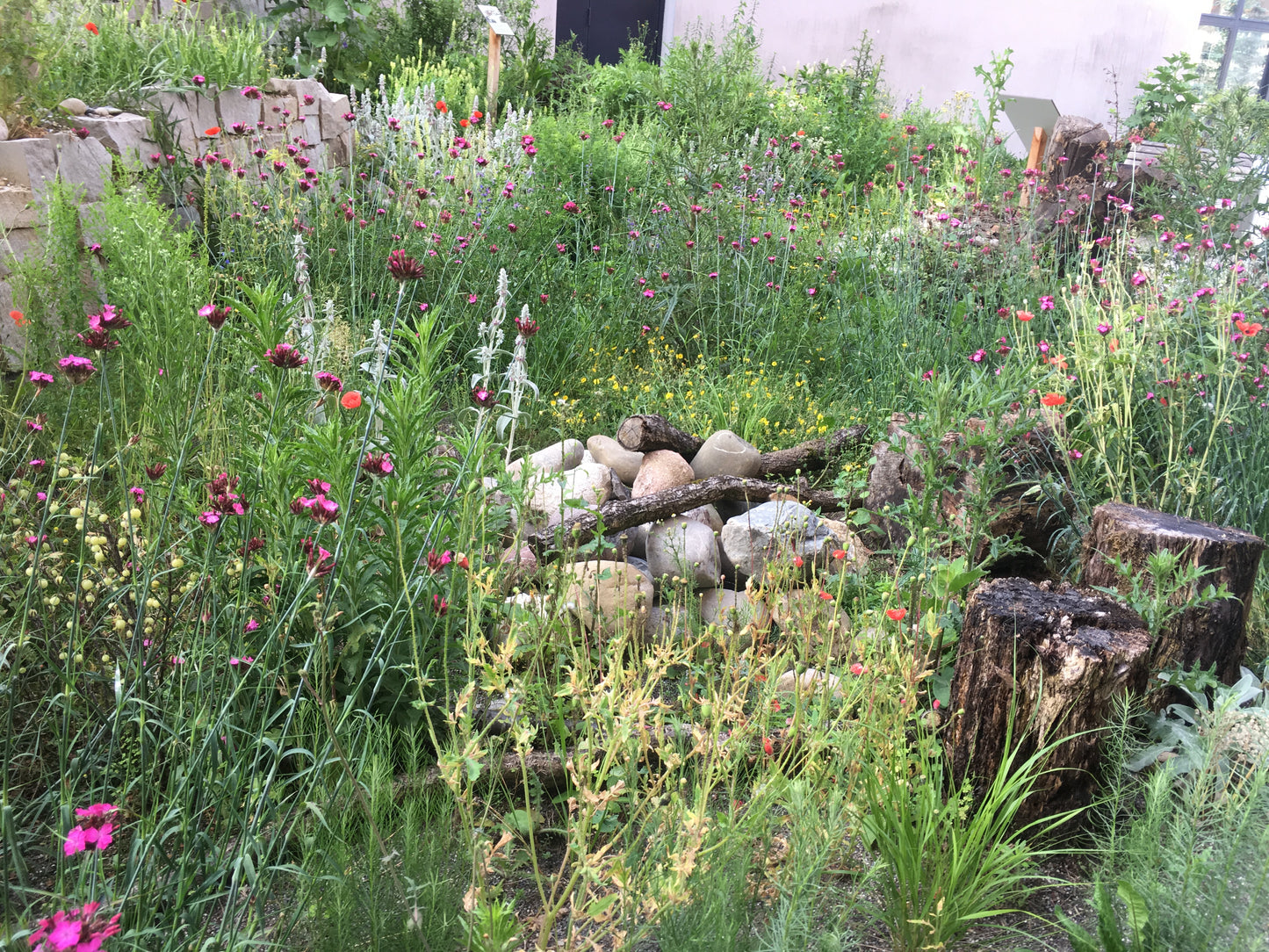
Similarly, our commitment to colorful meadows, blossoming agricultural practices, and public green spaces is always a commitment to climate protection: One hectare of species-rich grassland, for example, binds six tons of CO2 from the atmosphere annually and stores it in its root zone. Thus, a flower meadow not only has higher species diversity than native forest, but it also binds more carbon during ongoing growth.
Public green spaces can offer a spectrum of habitats that are difficult to reconcile with agriculture – because farmers need productive soils and can therefore only promote nitrogen-tolerant plants. In communities, it looks completely different; nobody harvests potatoes from a roundabout. If we actively manage carbon flows, we can maintain species-rich public areas in favor of fertile arable land and, incidentally, bind CO2.
Ultimately, one thing is made perfectly clear to us: The only constant in nature is change. We can accept change and shape it through altered economic practices and methods. In theory, this is referred to as "change by design," i.e., change through deliberate shaping. Or we deny, hesitate, cling to ideologies and to how everything once was (which point in time or state in a constantly changing nature do we mean exactly?). However, since change is greater than us, it still catches up with us. That would then be "change by disaster." The Netzwerk Blühende Landschaft has always seen itself in the role of positively shaping the landscape. We choose the holistic approach: promoting biodiversity as the basis of life for plants, animals, and humans, and thus addressing climate change.
About Netzwerk Blühende Landschaft
The Netzwerk Blühende Landschaft is an association of conservationists, beekeepers, and farmers, as well as many organizations, who want to make the cultural landscape blossom again for all bees, butterflies & co. The holistic approach aims to motivate and enable all actors in the landscape to become active for pollinating insects. In total, this creates a colorful patchwork of different habitats – a blooming landscape.
