


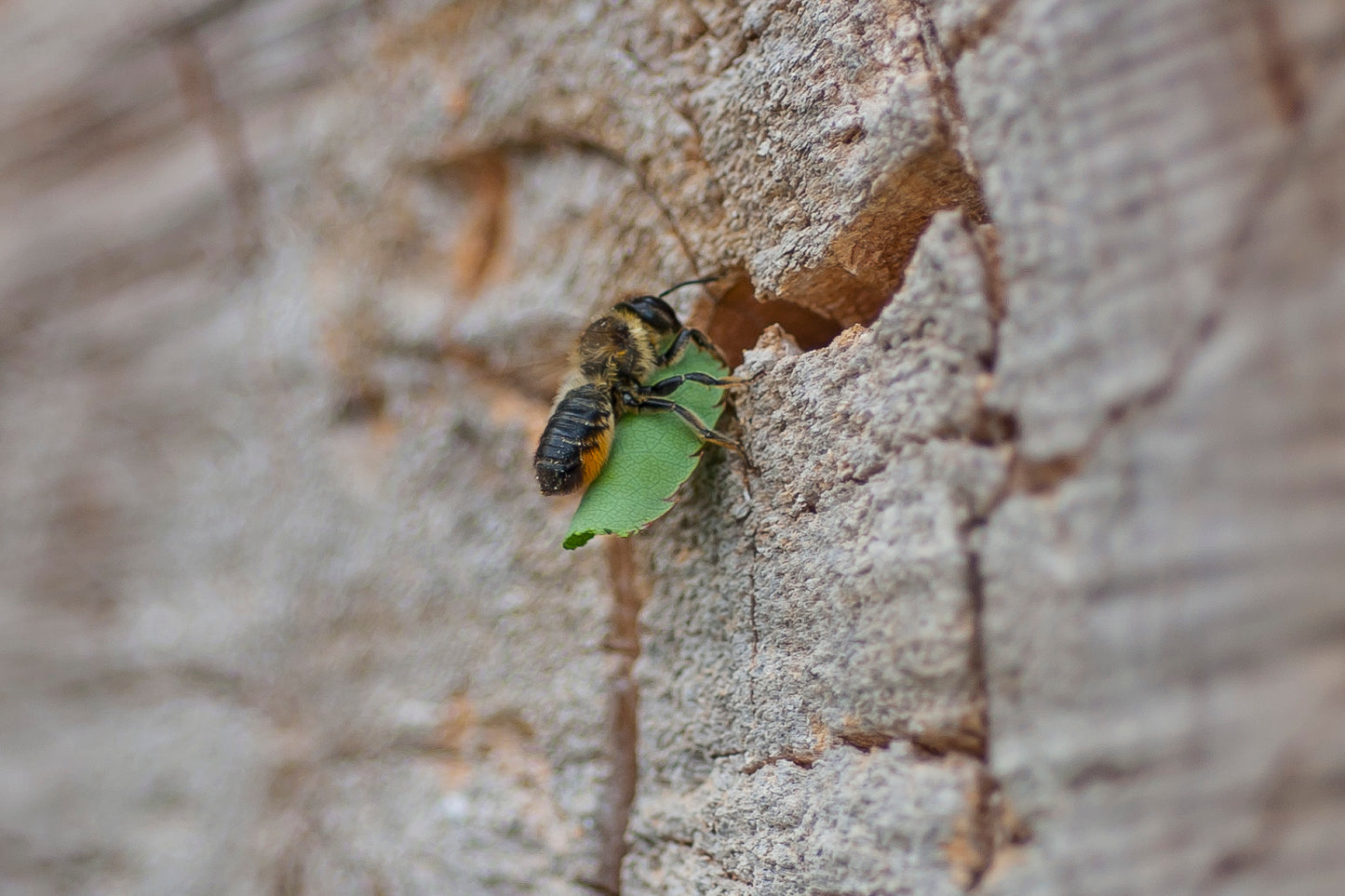
The fourth post is for advanced wild bee enthusiasts who want to transform their garden into an insect paradise.
Wild bees nest in a variety of materials. The more nesting opportunities different species find in your garden, the higher the probability that even rare species will settle there.
Rotten deadwood
Some wild bee species only nest in rotten wood. So get old, rotten wood from the forest or a farmer and place it in a sunny, ideally sheltered spot. The thicker, the better.
Particularly popular is so-called white-rotted wood. White rot is caused by a tree fungus that transforms the solid wood inside old trees over decades into a foamy, white, and very light mass. Old fruit trees are particularly often affected. Ask the local forester or a fruit farmer in the neighborhood.
Sand area
Over half of all wild bee species nest in the ground. Those who take the trouble to design a part of their garden accordingly will soon be rewarded by many wild bees quickly settling in the newly created nesting sites. Open, sunny sand areas that are unplanted or only lightly vegetated are particularly suitable for ground-nesting bees.
Here is a simple guide on how to create an attractive area for ground-nesters:
- Choose a sunny spot in the garden and remove the vegetation and the top 5-10 cm of soil.
- First, cover the area with a layer of wall gravel about 10 cm thick. This ensures good drainage of moisture.
- Surround the gravel area with larger stones or logs.
- Now add about 40 cm of sand to the gravel area.
- Place some larger stones in the sand. These help the wild bees orient themselves on the sand area and provide a warm microclimate. However, leave most of the sand area free.
- The area can be greened with a few very drought-resistant plants, e.g., thyme, rosemary, heather, sedum. The roots of these plants stabilize the sand area and protect it somewhat from erosion by rain and wind.
Wild bee expert Yannick Schauwecker shows in this short video how to create nesting opportunities for ground-nesting bees in the garden.
Tip 1: Use sand with a certain clay content if possible. Play sand for sandboxes is often well suited. Crushed sand does not work.
Tip 2: Sand is also excellent as a base for paths and small areas made of stone slabs. Wild bees like to dig their nests between the cracks.
Tip 3: Even those without a large garden can do something for ground-nesting wild bees. Our wild bee whisperer Yannick explains how in the video above.