


In our second post, you can read about the best nesting aids to support wild bees. Here too, small actions have a big impact. With simple measures, you can create valuable habitats.
While diligently nesting, wild bees fly back and forth between wildflowers and their nesting site. Therefore, the shorter their foraging flights, the more offspring these pollinating masters can provide with pollen and nectar. Do you already have some wildflowers in your garden or on your balcony? Also, provide suitable nesting opportunities – and transform your surroundings into a small paradise for wild bees in no time. For all nesting aids, wild bees prefer sunny and dry locations.
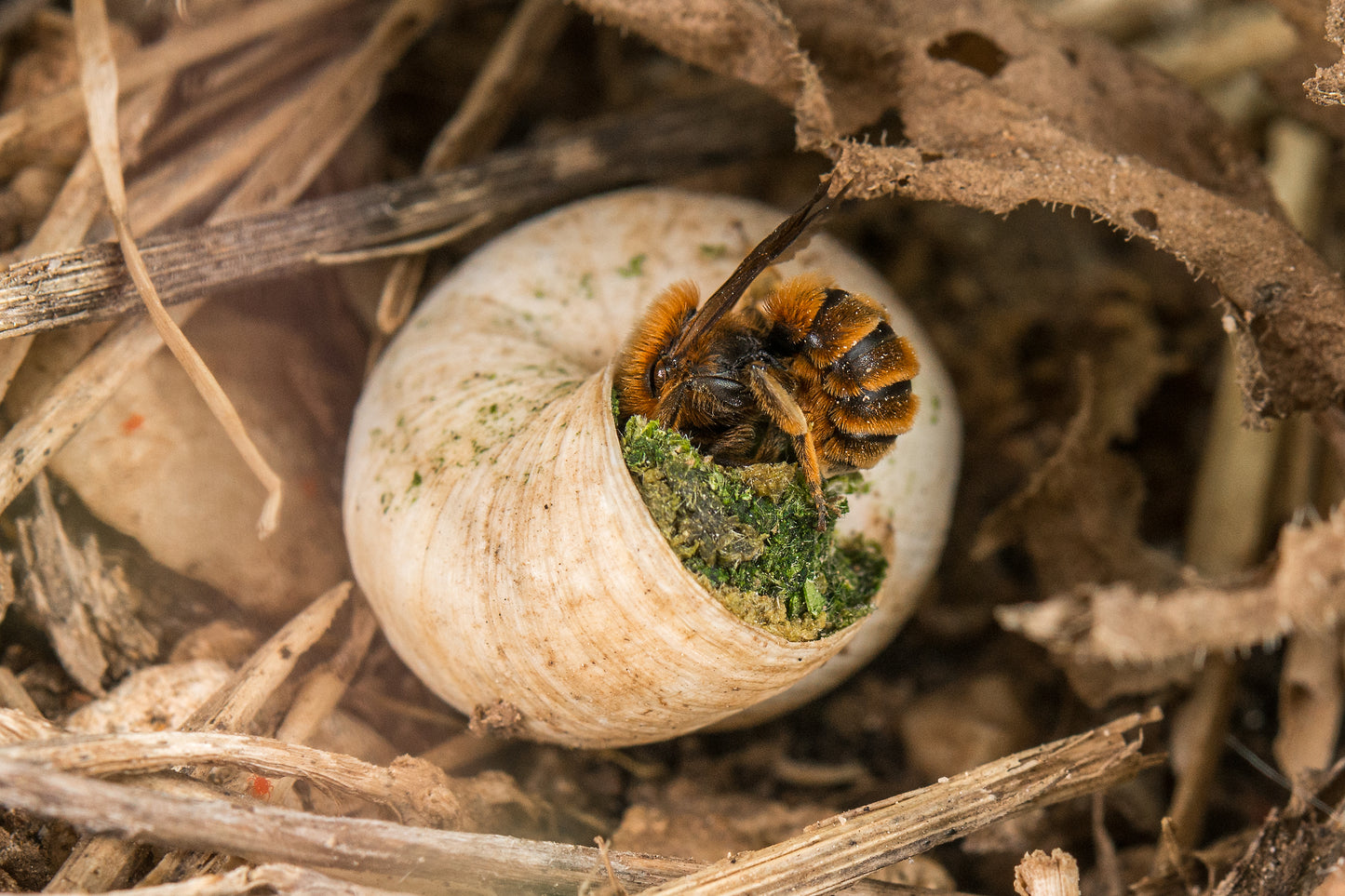
Empty Snail Shells for a Very Special Species
Particularly helpful – and easily combined with a nice walk in nature – is collecting empty snail shells. Rare Snail Shell Mason Bees nest in them. Place the snail shells in sunny, sparsely vegetated areas. It may take a while for the first females of this fascinating wild bee species to nest in them. But patience, as they say, makes the wild bee master! Once the Snail Shell Mason Bees discover the nesting aid, they build their brood cell spirally inside the snail shells and decorate it with plant mortar.

Pithy Stems for Important Specialists
There are wild bee species that only nest in pithy stems of elderberry, raspberry, blackberry, rose, or mullein. These nesting opportunities have become increasingly rare – but are very easy to provide: Cut about 30 cm long, as straight as possible, and finger-thick pieces from a bush of these plant species. Then attach them vertically to a fence or a post. Soon you will discover a small hole at the top, in the white, soft pith that runs through the entire stem. This was drilled by a small wild bee species, and its offspring are now nesting in the stem. Important: Leave the stems in place for at least two years. This is because the offspring that develop in the nests inside the stems only hatch the following year – and the cycle begins anew.


Wild Bee Houses for Busy Tenants
A simple and practical option is to provide wild bees with a wild bee house with suitable nesting tubes. In a BeeHome, for example, mason bees and many other wild bee species find ideal nesting conditions – and a starting population of harmless mason bees is also included. Discover our BeeHome now – and the fascinating world of wild bees.


Practical Nesting Block with Interesting Additional Material
Our BeeSummer add-on module is ideal for smaller wild bee species that are active in summer. It consists of a solid wooden block made of Swiss oak with many nesting holes ranging from 3 to 5 mm in diameter. The BeeSummer is attached to the BeeHome with strong magnets. You also receive an exciting brochure with portraits of the most important inhabitants of the BeeSummer.


Important for Craft Enthusiasts
If you want to build a wild bee house yourself, it is very important to consider a few basic principles. Unfortunately, many wild bee houses are not useful and remain empty – or even become a danger to the offspring. For example, use seasoned, not fresh wood, and reduce dangerous cracking when drilling by drilling into the end grain. Also, when using reed or bamboo tubes as nesting channels, the entrances must not be splintered. Completely enclosed plastic or glass tubes are dangerous for the offspring, as there is a risk of fungal infestation. Furthermore, wild bees do not inhabit perforated and hollow bricks, but rather extrusion-molded bricks.
And: When buying wild bee houses, also make sure that the material and construction are correct. Wood type, drilling method, and the condition of the nesting entrances play crucial roles.