Order your red mason bee (Osmia bicornis) cocoons and experience wild buzzing at your BeeHome! 🐝
The red mason bee is a typical synanthrope. While it is rare in nature, it feels very comfortable in gardens within settled areas: there and in nesting aids, it is very common. It is active early in the year and can be observed as early as March.
You can order at least 30 mason bee cocoons directly online via MyBeeHome from mid-February to May. Please note that you must register or log in with your email address for this. During the order process, you can provide your delivery address and choose the desired shipping date. Your mason bee cocoons will be sent by priority mail (A-Post).
With each of our BeeHomes or after participating in our wild bee care program, you will receive a voucher for red mason bee (Osmia bicornis) cocoons. If you have a voucher, you can enter it during the ordering process on MyBeeHome.


Pollination Heroine for our Nature
The red mason bee (Osmia bicornis) is a true all-rounder and an important synanthropic species that feels particularly at home in urban areas. With its cold resistance and preference for rose family plants, it is an indispensable helper in the pollination of fruits and berries.
Perfect for a buzzing spring
These charming wild bees are not only a fascinating sight, but also extremely efficient: from as early as March, you can observe them collecting pollen from various plants – from apple and cherry blossoms to buttercups and oaks. The red mason bee is less selective and offers your garden or balcony an impressive variety of pollination services.
The red mason bee is 8–12 mm in size and its entire body is very hairy and fluffy. Its appearance is rather stocky; in size and color, it resembles a honey bee. The females of the red mason bee have two horn-like protrusions on their heads, hence the scientific name suffix bicornis = two-horned. The females have a black head and a brown to fox-red body. The very end of their abdomen is black again. The males are brownish to fox-red and have a striking white pubescence on the clypeus. They are also considerably smaller than the females.
March to June. One generation per year.
The Red Mason Bee is not particular about its choice of flowers and collects pollen from various herbs, bushes, and trees. It visits flowers from over 19 plant families, often preferring Rosaceae. These include the blossoms of apple, cherry, apricot, and other important cultivated plants. Other popular pollen plants include oaks, maples, buttercups, and wild mustard.
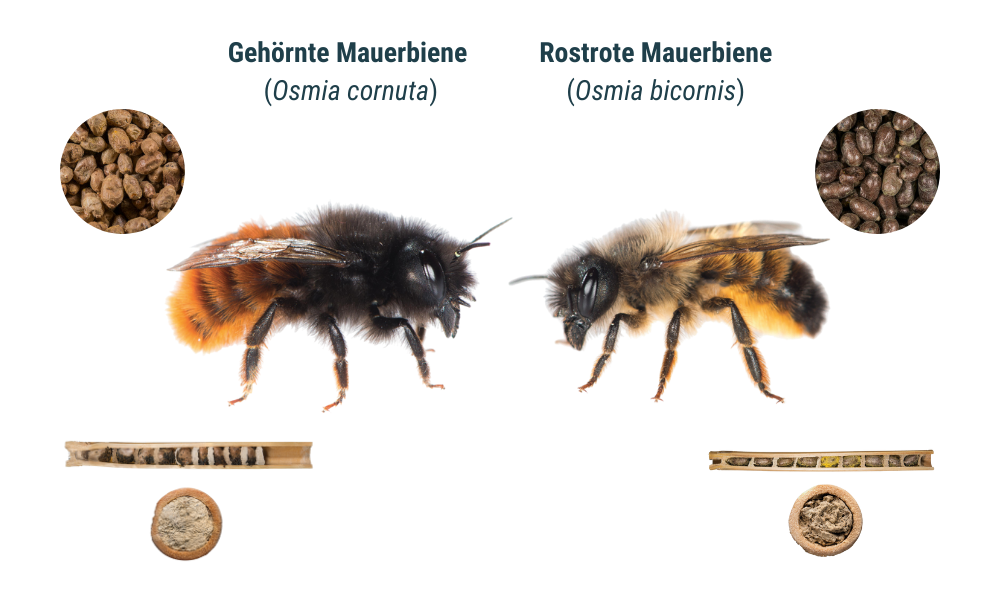
The Red Mason Bee uses clay as building material for the cell partitions and the nest plug. Unlike the nest plug of the Horned Mason Bee, that of the Red Mason Bee is less carefully crafted and crumbly instead of smooth.

An unbeatable duo
Red Mason Bees and Horned Mason Bees
The Red Mason Bee complements the Horned Mason Bee (Osmia cornuta) perfectly, as the latter becomes active a few weeks earlier.
The Horned Mason Bee is a somewhat more robust and fluffier species. Both species are very similar in their pollen-collecting behavior, although the Red Mason Bee has a slightly broader diet, and the Horned Mason Bee shows an even stronger preference for fruit blossoms.
When it comes to nest building, the species can be easily distinguished by their nest closures: the nest closures of the Horned Mason Bee are characterized by a very fine and even texture, whereas the Red Mason Bee works a bit more roughly, and its closures have an irregular surface.
Together, both species ensure a healthy, vibrant garden and actively contribute to the preservation of our nature.
Life cycle of the Red Mason Bee at a glance
The initial population of red mason bee cocoons guarantees exciting observations at your BeeHome. Experience how the diligent pollinators hatch, pollinate plants in your area, and care for their offspring.
Hatching
Hatching
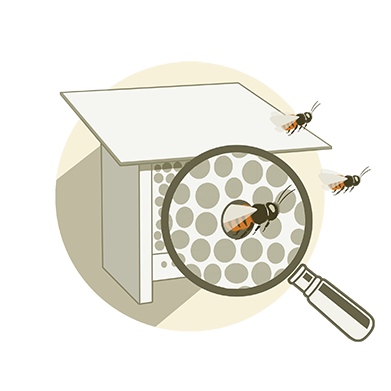
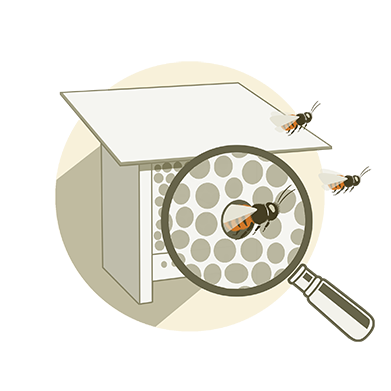
Mason bees emerge as soon as temperatures rise. First, the males emerge, waiting a few days for the female mason bees. Then, mating occurs. The males live for about 2-3 weeks after emerging, and the females for about 4-7 weeks.
Pollination
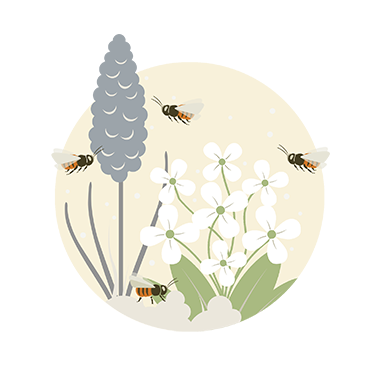
Pollination
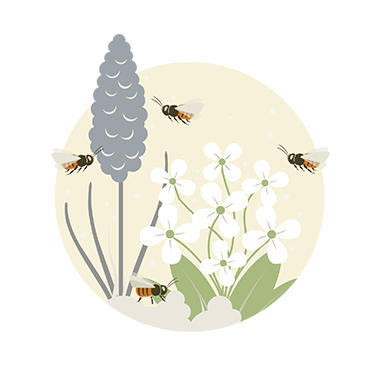
The female mason bee strengthens herself with flower nectar, while her ventral brush is ideal for collecting pollen. While foraging, she pollinates more than 2,500 flowers a day. Over her entire lifetime, she pollinates more than 40,000 flowers, which corresponds to the pollination performance of 80 to 300 honey bees.
Nest-building
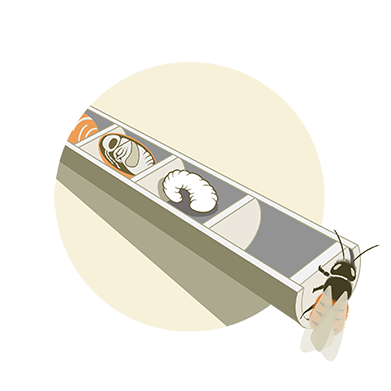
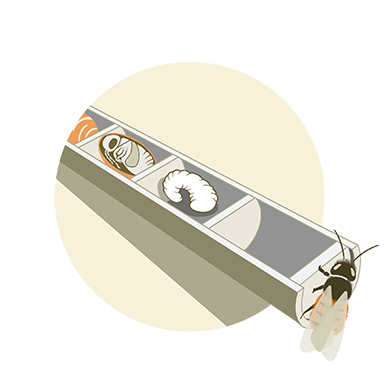
Nest-building
After mating, the female mason bee seeks out a nesting tube in the BeeHome and diligently collects the pollen-nectar mix for her offspring. The female mason bee lays one egg on each pollen loaf, from which a larva hatches. This develops into a fully grown mason bee in its cocoon by autumn.
Hibernation
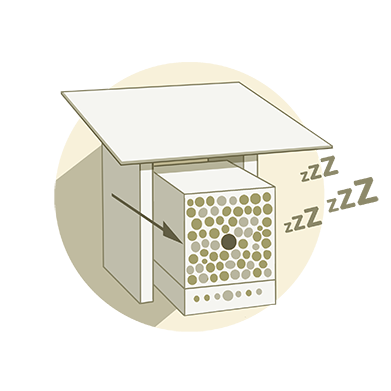
Hibernation
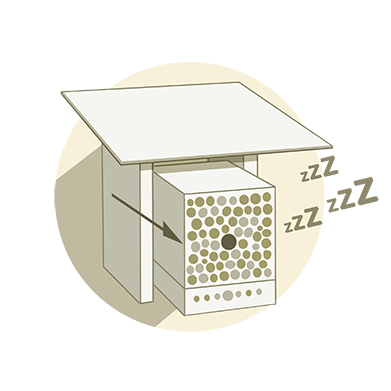
The mason bee larvae developed into adult wild bees in the nesting tubes of your BeeHome between spring and autumn. They now overwinter as adults in their cocoons for at least 90 days. The offspring emerge from their cocoons the following spring, and the buzzing adventure begins anew!