


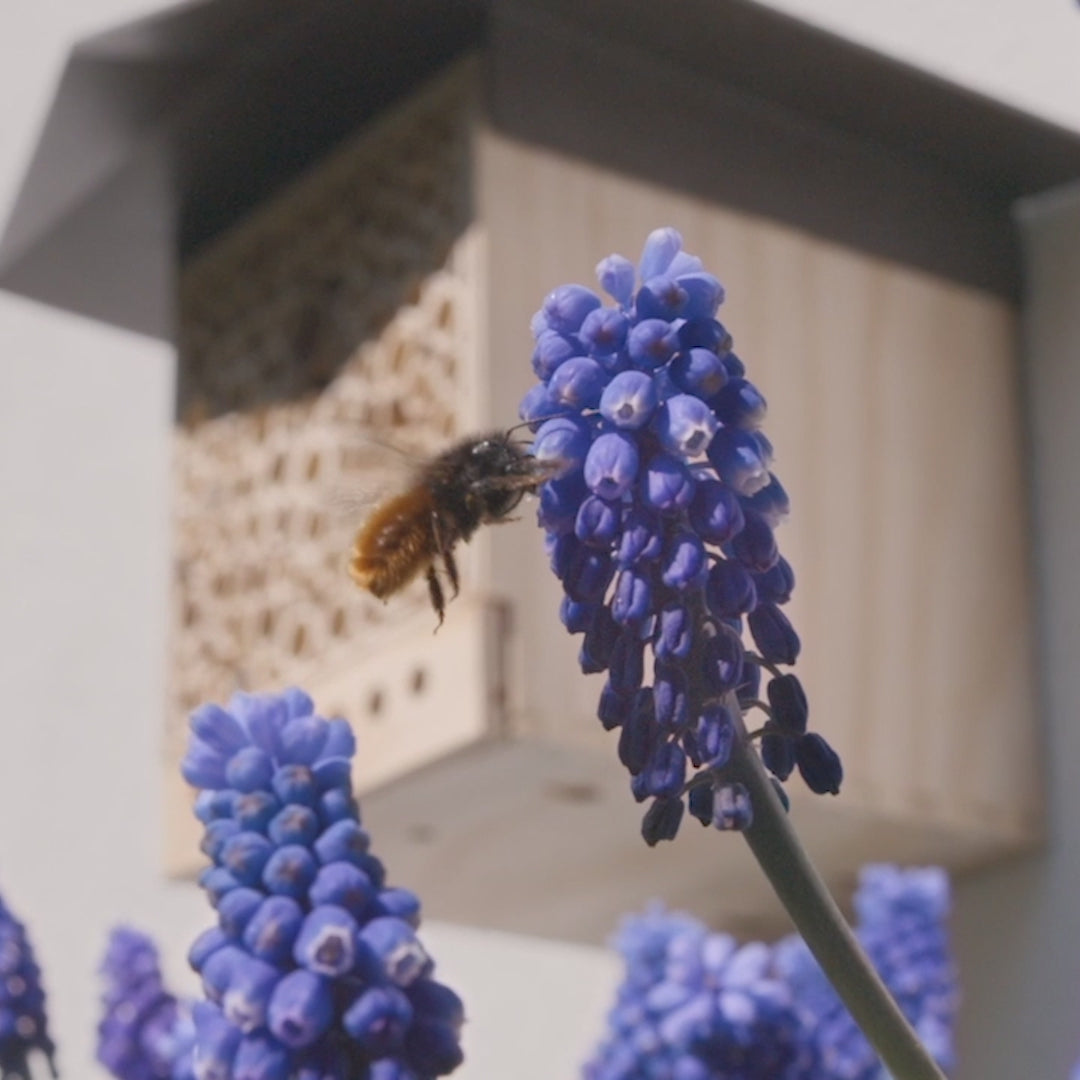


The European orchard bee is one of the species very frequently observed at nesting aids. It is widespread throughout Switzerland and rarely occurs above 1000 m above sea level. Its cold resistance and its preference for rose plants make the European orchard bee the undisputed pollination professional among European bee species. It particularly demonstrates its advantages in early-flowering crops such as apricots, cherries, and plums.
Each cardboard tube contains about 25 cocoons of the European orchard bee (Osmia cornuta). As soon as you receive your cocoons, please immediately place the tube outside in your BeeHome and open the lid so that the bees can hatch.
Please note: With each of our BeeHomes or after participating in our wild bee care program, you will receive a voucher for cocoons of the red mason bee (Osmia bicornis). This voucher is not applicable for the cocoons of the European orchard bee (Osmia cornuta). Unlike with red mason bees, you do not need to choose a shipping day for European orchard bees.

The early bird among wild bees
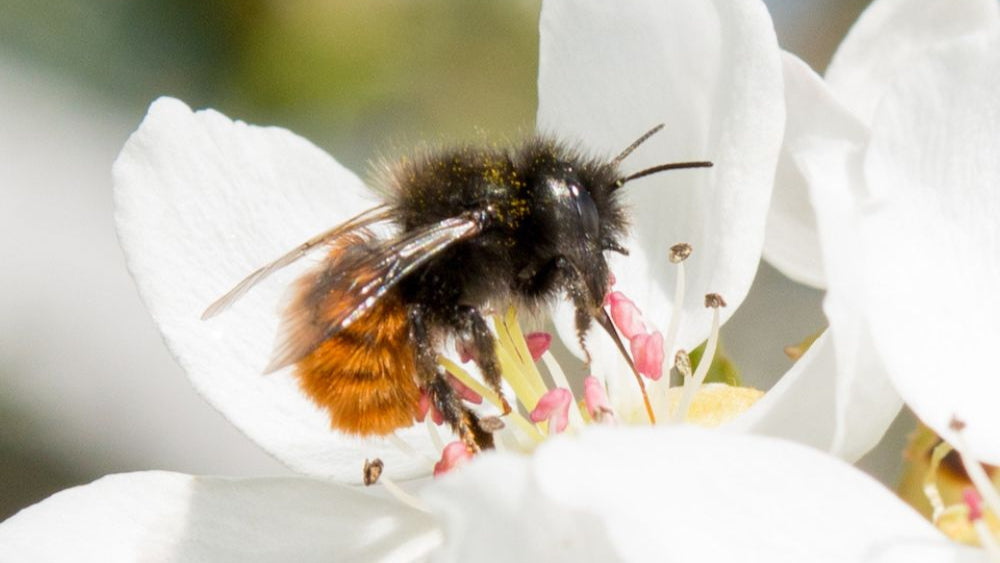
The especially fluffy hornfaced mason bee hatches several weeks earlier than the red mason bee (Osmia bicornis), whose cocoons you would otherwise receive for your BeeHome. Both species get along very well. The hornfaced mason bee is an absolute early starter, flies even in cool weather and sunshine, and is an excellent pollinator. This way, you have the opportunity to start your buzzing spring as early as February and then receive cocoons of the red mason bee.
The European orchard bee is 8–15 mm long and has a densely hairy body. Its appearance is very similar to that of a bumblebee. The head and upper body are deep black, and the abdomen is a striking fox-red color. It is named after the two small horns below the eyes of the females. The males are slightly smaller and have conspicuous white hair on their clypeus.
February to June. One generation per year.
The European Orchard Bee is not picky and collects its pollen from various herbs, bushes, and trees. It visits blossoms from over 13 plant families, preferring fruit and berry blossoms. Other popular pollen plants include maple, corydalis, grape hyacinths, and wild mustard.
The European Orchard Bee uses clay as a building material for its cell partitions and nest seal. The latter, unlike that of the very similar Red Mason Bee, is carefully smoothed down.

An unbeatable duo
Horned Orchard Bees and Red Mason Bees
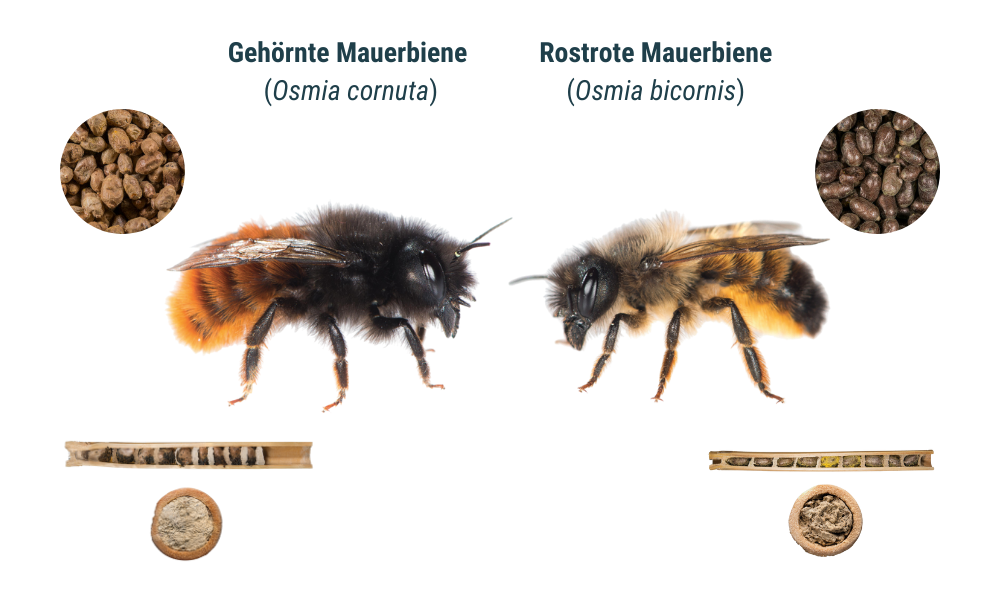
The horned orchard bee perfectly complements the red mason bee (Osmia bicornis), whose cocoons you would otherwise receive for your BeeHome.
The horned orchard bee is the somewhat more robust and fluffier species. Both species are very similar in their pollen-collecting behavior, with the red mason bee having a slightly broader diet and the horned orchard bee showing a slightly stronger preference for fruit blossoms.
When it comes to nest building, the species can be easily distinguished by their nest closure: the nest closures of the horned orchard bee are characterized by a very fine and even texture, while the red mason bee works a little more roughly and the closures have an irregular surface.
Together, both species ensure a healthy, lively garden and actively contribute to the preservation of our nature.
A Glimpse into the Life of the Horned Mason Bee in Your BeeHome
As diverse as wild bees are, so are their lifestyles and their life cycles. We will show you the life cycle of the European orchard bee (Osmia cornuta) in your BeeHome.


We will take care of it, of course.
Personally there for you
Our small team of enthusiastic experts will be happy to personally assist you as you buzz into spring!
Do you have any questions or suggestions? Check out our FAQ or contact Antonia, Agnes, or Cornelia directly.
You can chat with us live or reach us by phone from Monday to Thursday. Outside our business hours, you can always send us an email at info@wildbieneundpartner.ch – we will take care of your request as quickly as possible.