

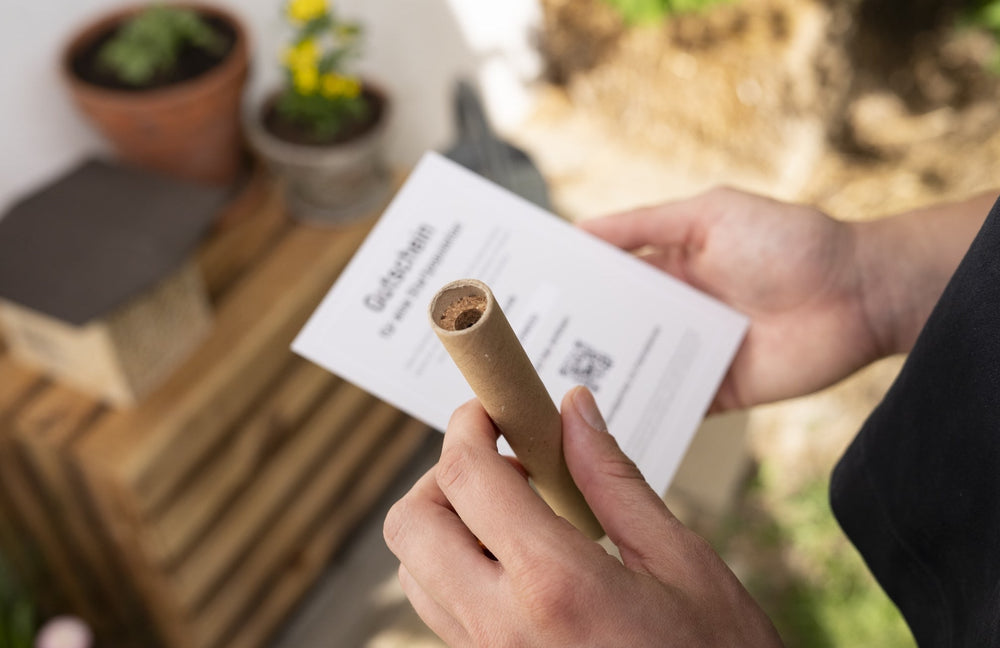
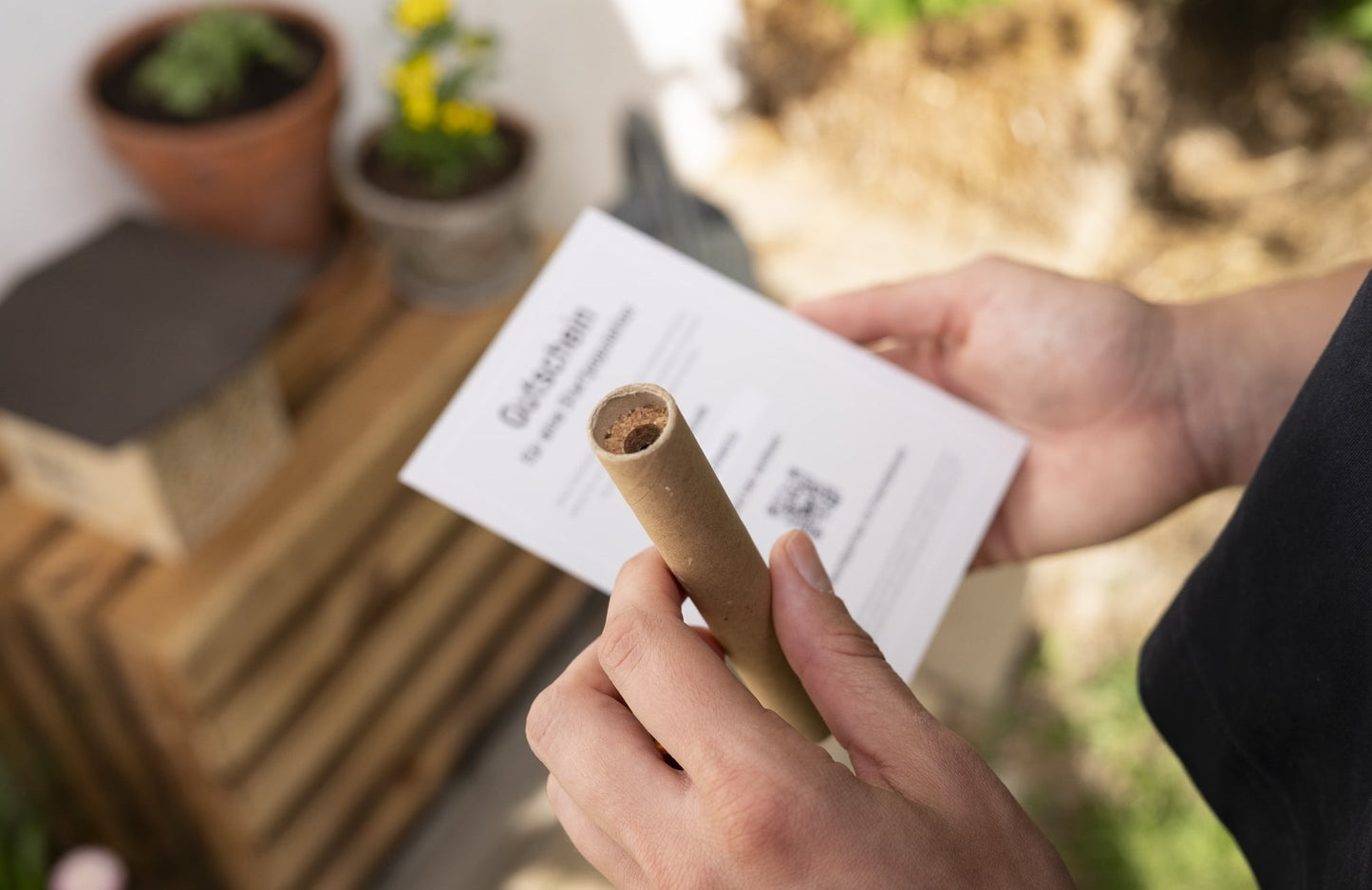
What is a starter population with mason bee cocoons?
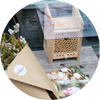
With your starter population, you will receive mason bee cocoons in diapause, which you can only order online in spring. The mason bee cocoons are sent by letter post in a cardboard tube - well protected in their own cocoons.
On the day of delivery, place your starter population outside at the bee hotel and remove the colored lid. Depending on the temperatures and the development of your mason bee cocoons, you will soon be able to observe how the mason bees crawl out of the tube, and the buzzing adventure begins.
How to Place Your Starting Population
In this video, Mara shows you how to easily place one or more starter populations of mason bee cocoons in your BeeHome. You can marvelously provide even more wild bee power by ordering additional starter populations.
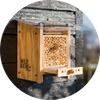
Place the BeeHome on a weather-protected wall, at least 50 centimeters above the ground. A house wall that is exposed to the sun in the morning, i.e., facing east to south, is ideal. You can also place the BeeHome on a solid surface such as a windowsill or a table. Mason bees avoid damp places. In addition, your BeeHome will last longer if you hang it in a well-protected spot.
We recommend not hanging the BeeHome on a tree. Firstly, pollen-robbing ants can quickly gain access to the BeeHome, and secondly, the BeeHome is exposed to shade, moisture, and wind. Wild bees avoid damp and dark places, which means they will look for another nesting spot.
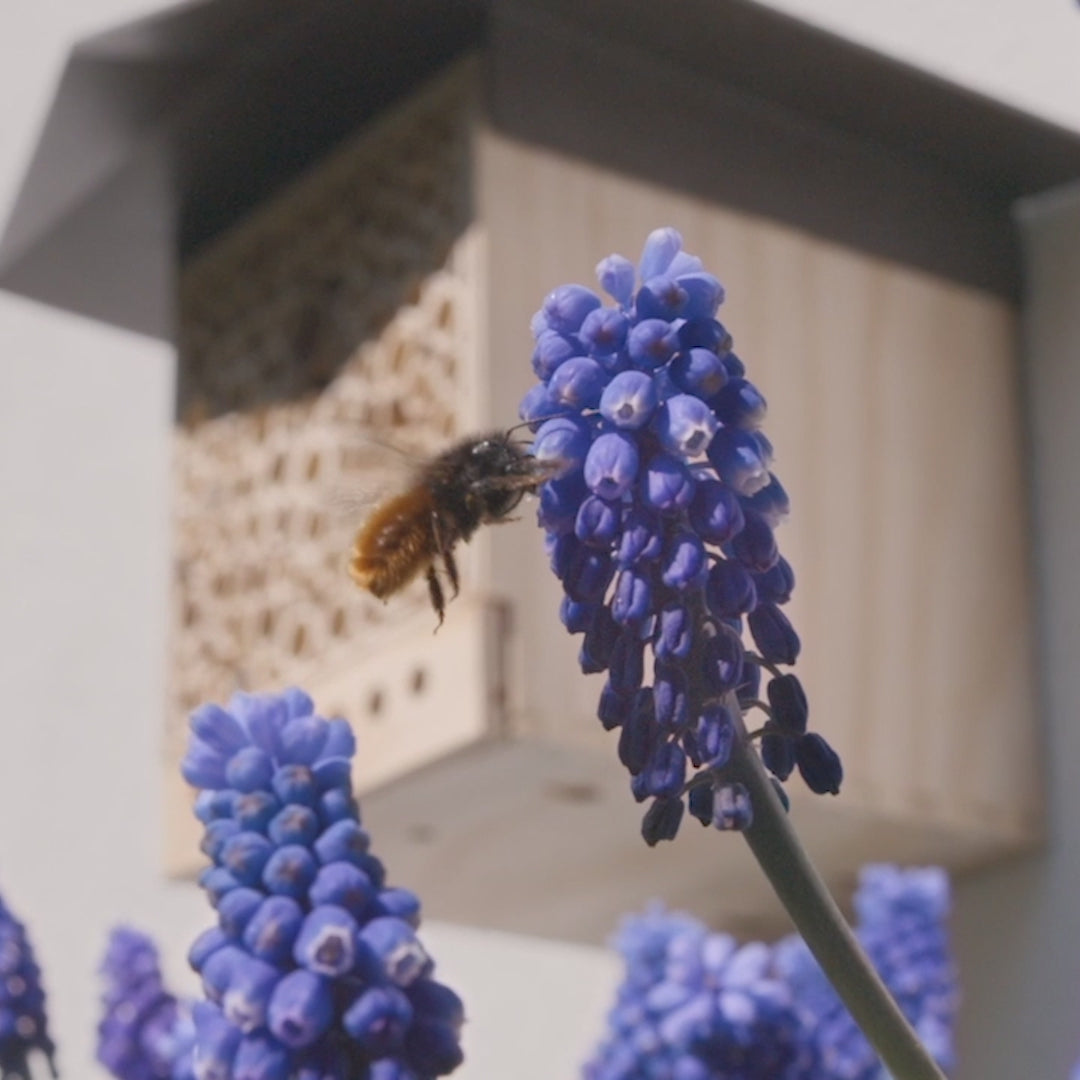
Wild bees feed themselves and their offspring on pollen and nectar. By offering native wildflowers or fruit blossoms in the immediate vicinity of the BeeHome, you ensure that the mason bees find sufficient food and at the same time increase the likelihood that they will build their nests in the BeeHome.
The flight window for the red mason bee is between March and June, depending on the respective weather conditions. The horned mason bee, as an early starter, is already out and about in February.
A mason bee hatches as soon as temperatures rise. This can take up to 30 days. On the day of delivery, place your starter population outside at the bee hotel and remove the colored lid. Depending on the temperatures and the development of your mason bee cocoons, you can soon observe how the mason bees crawl out of the tube, and the buzzing adventure begins. On this page, we present the life cycle of the red mason bee.
Yes, you are welcome to place multiple starter populations in your BeeHome at the same time - full bee power! :-)
You can attach additional starter populations either below your BeeHome or on the side with some adhesive tape. Alternatively, you can place the tubes in a dry, shady outdoor location near your BeeHome. Do not expose the tubes to direct sunlight and do not place them under the roof, as it could get too hot there.
The Horned Mason Bee hatches a few weeks before the Red Mason Bee, whose cocoons you would otherwise receive for your BeeHome. If you have a voucher for a regular starter population with Red Mason Bee cocoons, you can order these from the beginning of March. Of course, you can also have both species flying around and thus observe wild bees over a longer period – the two mason bee species get along excellently.
Wild bees are living creatures. Treat them responsibly.
- Do not release mason bees into nature reserves.
- Above 1200 m above sea level, red mason bees no longer occur naturally. Therefore, for the well-being of the mason bees, do not place your bee hotel in higher altitudes.
- Observe local regulations regarding the relocation of mason bees.
- Mason bees love bright and dry conditions. We recommend attaching your bee hotel in a sheltered, sunny location.