

In the lives of young wild bees, everything runs according to plan: They hatch from their eggs in spring, eat their food reserves, spin a cocoon, and finally go into hibernation from autumn onwards – and all mason bees of a species do this almost simultaneously. But how do wild bees in their dark chambers know that it's time for the next stage of life?
Metamorphosis still a mystery
We have to admit that we cannot answer this question with certainty. However, we suspect that it works like this: When the larva's food supply is exhausted and it is hungry, it spins the cocoon and starts metamorphosis. This means that the larva transforms into an adult bee in several steps. When it gets hot in summer, it's time for summer dormancy. At the beginning of autumn, it completes its transformation into a fully developed mason bee and begins its winter dormancy.
How does the internal clock of wild bees work?
In spring, it's exactly the opposite. When it gets warm, it's time to hatch. But the matter is a bit complicated: If the mason bees were to hatch at the first warm temperatures, this would be fatal. It could just be a few warm days in December or January, long before blooming spring begins. Then the mason bees would hatch but would find no food.
To realize that it really is spring, a second piece of information is needed: How long was it actually cold? If it was only six weeks cold before the warm days, the wild bees know that it is too early to hatch. But if it was cold for six months, spring is here. The mason bees measure this using a complicated internal clock, which is presumably controlled by hormones. However, we don't know exactly how.
Some bees intentionally oversleep
For other bees, it is even more complicated. Many wild bees overwinter as larvae or pupae. Before they hatch, they must first complete metamorphosis (transformation from larva to fully developed insect). The processes described above therefore only trigger metamorphosis in spring. Only then can the bees hatch. This is one of the reasons why wool carder bees hatch much later than red mason bees. In other species, some animals even intentionally oversleep one summer and hatch a year later than their siblings. In this way, some animals survive even a bad year. This is often the case with specialists like the viper's bugloss mason bee, which depends on very specific food plants.
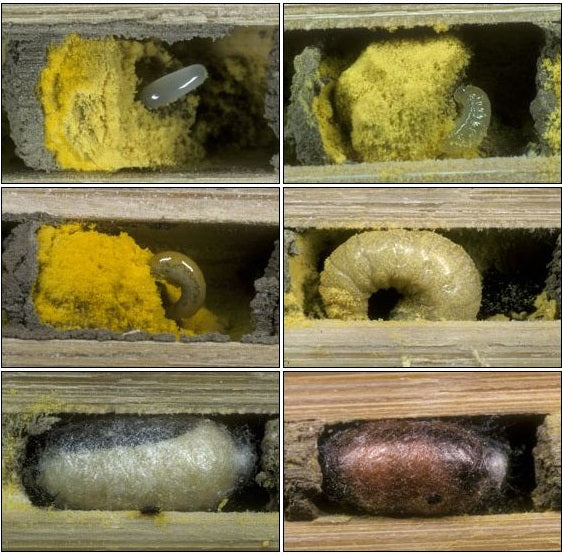
Development of the mason bee from larva to adult wild bee in the cocoon
Over millions of years, insects have also found ways to overcome the great challenges of the cold season and arrive well in spring. Most of them hibernate in some way – either as an egg, larva, pupa or as an adult animal. The latter applies to the red and horned mason bees in your BeeHome.
Between spring and autumn, the larvae in the nesting tubes of your BeeHome develop into adult wild bees.
Exactly what triggers these developmental steps is not certain.