

Most people associate wasps with very negative experiences. But this bad impression is caused by only a few species. In the large group of wasps, there are many incredibly fascinating species. A few of them can also settle in your BeeHome. Look forward to it, it's worth it!
Mason bees and wasps—how similar they are
There are several hundred species of wasps in Switzerland. They are closely related to bees; both share common ancestors. That's why wasps and bees are similar in appearance and behaviour: some form colonies, some build nests in the ground, and some build nests in small cavities, like in your BeeHome. However, there is one important difference between bees and wasps: bees are vegetarians, and wasps are carnivores. Hence the saying: Bees are vegetarian wasps.
When we think of wasps, most people have one of these species in mind: the German wasp (Vespula germanica) and the common wasp (Vespula vulgaris). These are the pesky, black-and-yellow wasps at your cake. These two species are social wasps that build large nests, for example, in the ground or in the attic. Therefore, these animals are not found in the BeeHome. Only solitary wasps, i.e., loners, nest here. These relate to the German wasp as the honeybee relates to the mason bee: the same name, but otherwise not much in common. So, if you see a wasp nesting in your BeeHome, it is certainly not one of the troublesome species.
Just like solitary bees, solitary wasps living in Switzerland are harmless to humans. They are not interested in food and drinks and are absolutely peaceful. Like all wasps, they have a sting, but it is small and can barely penetrate human skin.
So, some of these interesting, solitary wasps can settle in your BeeHome. Solitary wasps show similar behaviour to your mason bees: They carry food for their young into a tube, lay an egg, and seal the whole thing with clay. However, solitary wasps do not collect pollen but aphids, beetle larvae, caterpillars, spiders, etc. These are stunned with a sting and brought into the nest. In doing so, these wasps also contribute to reducing pests in the garden.
These solitary wasps can nest in the BeeHome
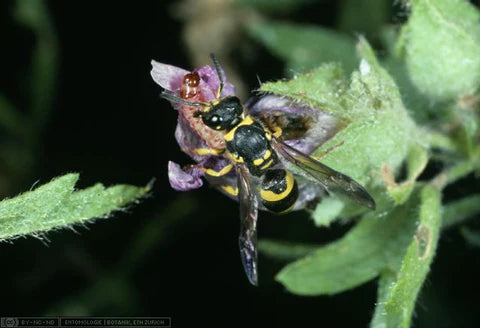
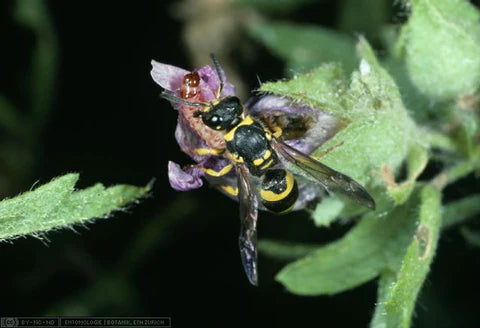
Potter Wasp (Ancistrocerus gazella)
A small black and yellow wasp, very common, most likely to be observed at BeeHome.
- Size: 7–11 millimeters
- Habitat: Diverse, sun-exposed, frequently in settlements
- Flight period: End of April to end of October, two generations
- Diet: Adult potter wasps often feed on nectar and pollen. The larvae are supplied with small butterfly caterpillars.
- Nest closures: Clay, similar to mason bees
Image: Albert Krebs. The potter wasp hunts insects and other protein sources to feed its offspring.
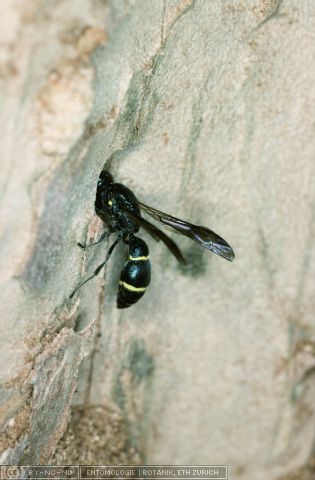
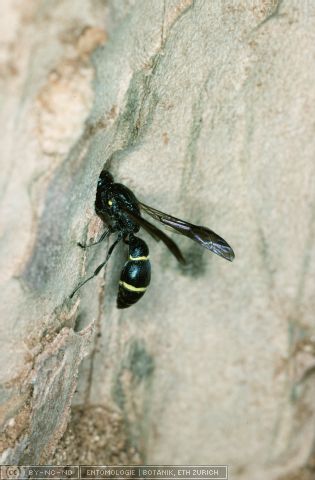
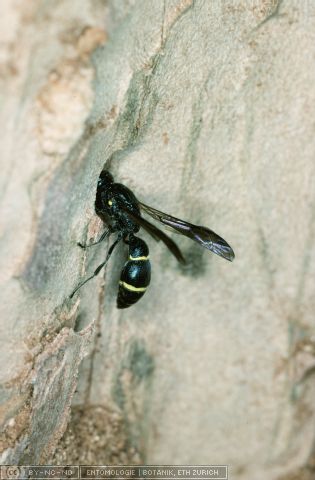
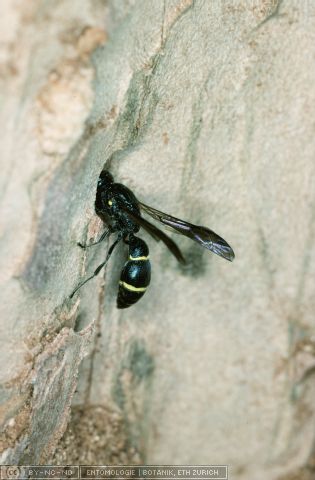
Two-banded Mason Wasp (Symmorphus bifasciatus)
Very similar in appearance to Ancistrocerus gazella, but somewhat rarer. However, they do not hunt butterfly caterpillars, but rather leaf beetle larvae. This is the best distinguishing feature.
- Size: 7–11 millimeters
- Habitat: Diverse, often in settled areas
- Flight period: Early May to late September
- Diet: Larvae are fed leaf beetle larvae
- Nest closures: Loam, similar to mason bees
Image: Albert Krebs. Two-banded mason wasp at the nest entrance. This species sometimes nests in the BeeHome.
Passaloecus corniger
Representative of several similar species. These are all small and black and indistinguishable from each other without a microscope.
- Size: 4–7 millimeters
- Habitat: Diverse, common species, up to 1900 meters altitude
- Flight period: June to September
- Diet: The larvae are fed with aphids, up to 25 per larva. These are not always hunted by the bee itself, but sometimes stolen from other nests.
- Nest closures: Resin, similar to resin bees
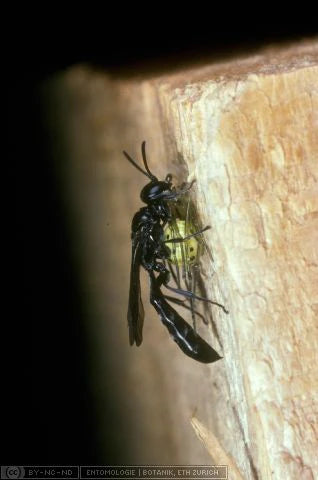
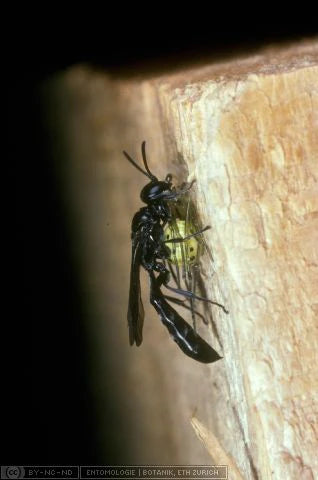
Potter Wasp (Trypoxylon figulus)
Representative of several Trypoxylon species. Sometimes clears out the nests of other wasps.
- Size: 7.5–12 millimeters
- Habitat: Diverse, common species
- Flight period: Late May to September, two, sometimes three generations per year
- Food: Larvae are fed with spiders. The larvae consume these in only 5 to 7 days.
- Nest closures: Loam, similar to mason bees
Image: Albert Krebs. The potter wasp provisions its larvae with spiders.
Fascinating insights with the BeeHome
The BeeHome can also become a nesting site for other fascinating wild bee species. Start your adventure now!