


WILDBEE NESTING AIDS
The ideal location for your BeeHome
Anyone who wants to give wild bees a home with a BeeHome will naturally ask themselves: Is my garden or balcony even suitable as a location for a wild bee house and where is the best place to put the BeeHome?
We can tell you in advance: there is a suitable spot in all apartments and houses where the wild bees will feel comfortable. You can find the detailed answers here.
Dry & sunny location for your BeeHome
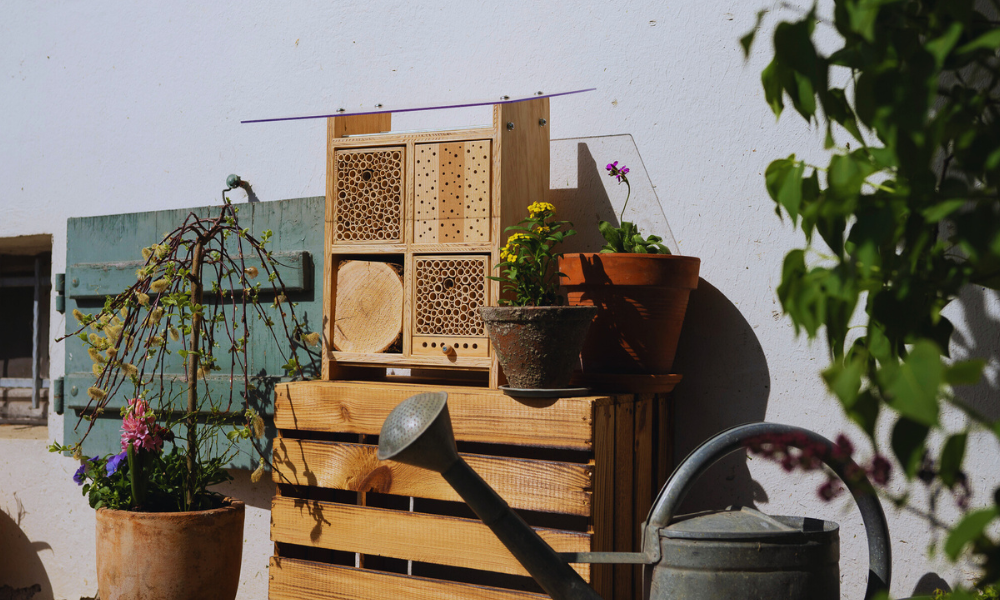
Place the BeeHome on a weather-protected wall, at least 100 centimetres above the ground. An ideal location is a house wall that receives morning sun, meaning it faces east to south. The earlier the morning sun wakes up the industrious mason bees, the more time they have to collect pollen for their offspring. This allows them to lay more eggs, ensuring as many offspring as possible hatch in the following year. In any case, avoid walls overgrown with ivy, as these are usually damp.
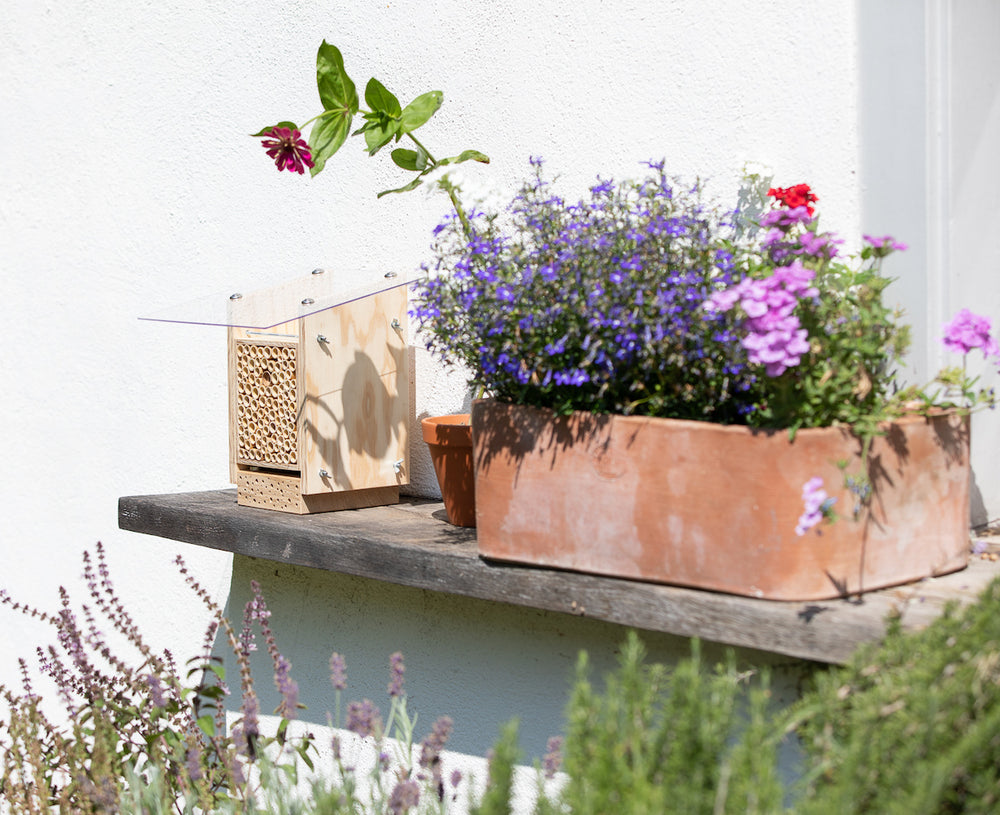
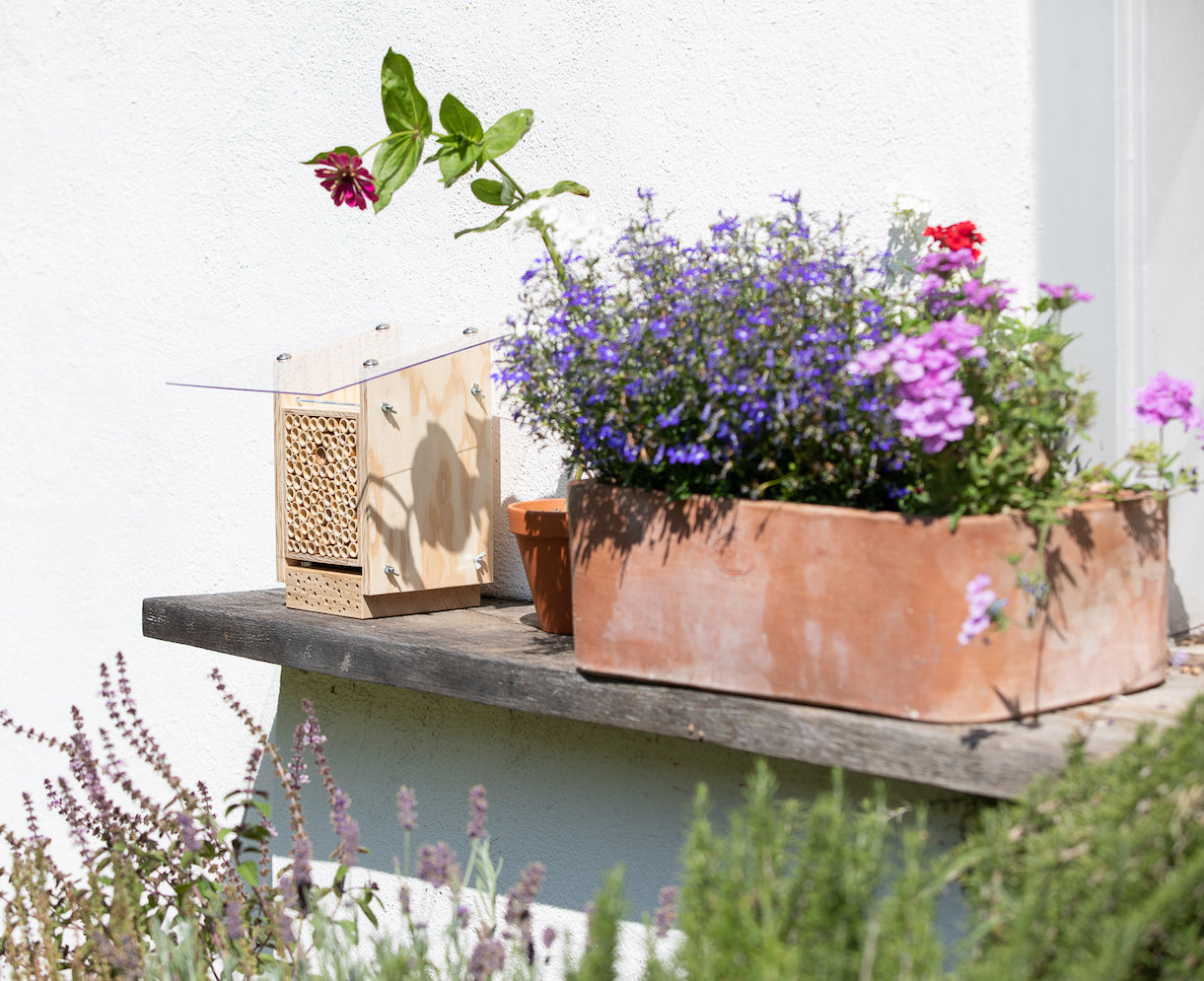
You can also place the BeeHome on a stable surface such as a windowsill. Mason bees avoid damp places. Additionally, your BeeHome will last longer if you hang it in a well-protected spot.
We recommend not hanging the BeeHome on a tree. Firstly, pollen-robbing ants can quickly gain access to the BeeHome, and secondly, the BeeHome will be exposed to shade, moisture, and wind. Wild bees avoid damp and dark places, which means they will look for another nesting site.
Early Blossoms in the Area
Wild bees feed themselves and their offspring on pollen and nectar. By offering native wildflowers or fruit blossoms in the immediate vicinity (a maximum of 200 to 300 meters around the BeeHome), you ensure that the mason bees find sufficient food and increase the likelihood that they will build their nests in your BeeHome and not simply move on to find a better spot.
With these wildflowers, you offer red mason bees and other early flyers valuable nourishment: scilla, grape hyacinths, aubrieta, lungwort, Christmas roses. You can also plant bulbs like scilla and grape hyacinths in the autumn.
Mason bees also particularly like cherry trees or early-flowering woody plants such as blackthorn or willows.
Loose loamy soil near your BeeHome
This condition is almost always met. Mason bees need loose, loamy soil in the vicinity of the BeeHome to seal their brood cells. If this is in short supply, you can simply place a tray with loose soil. Please remember to moisten it occasionally. The bees cannot work with soil that is too dry.
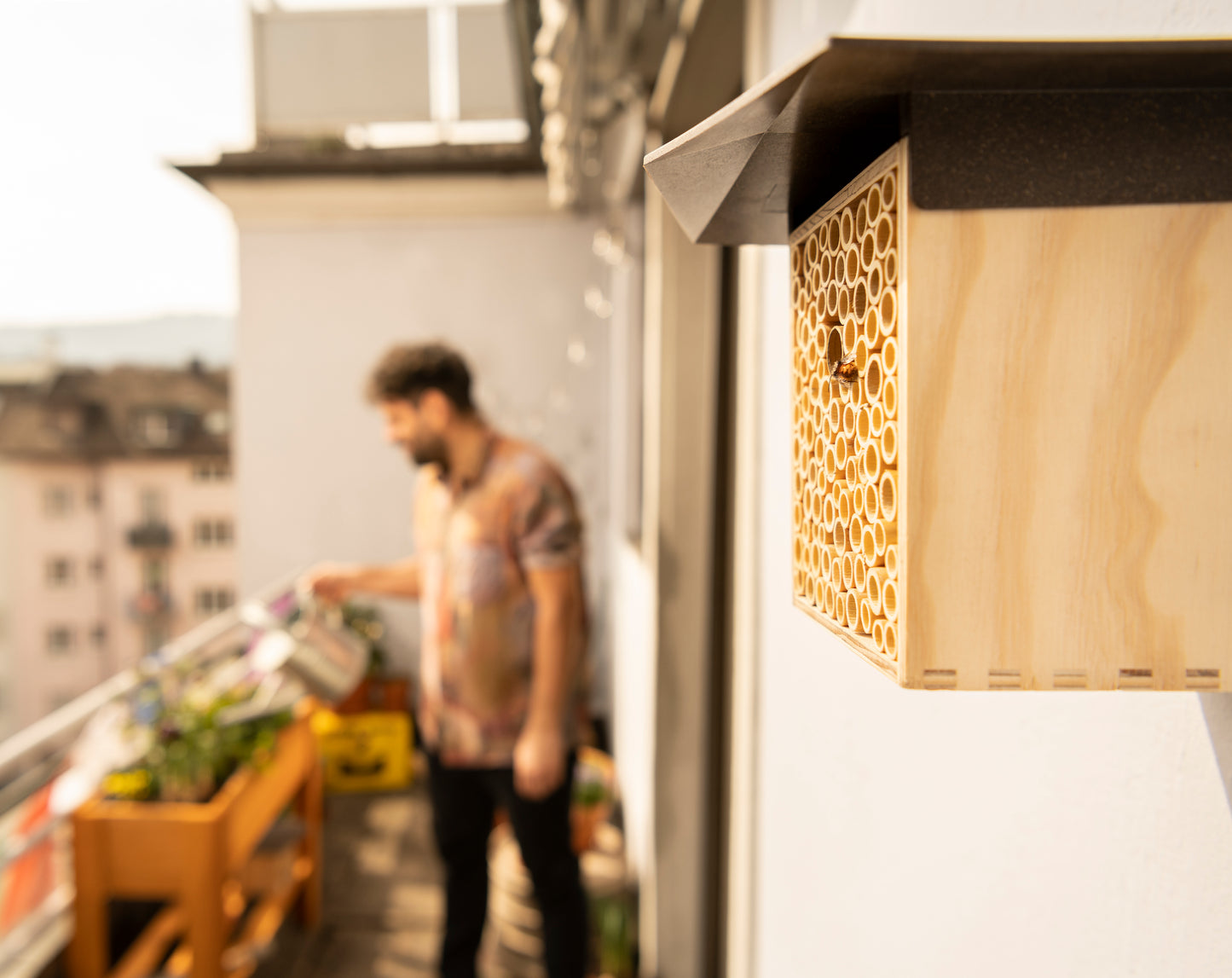
Are the mason bees thriving here?
Your BeeHome in the city or on a balcony
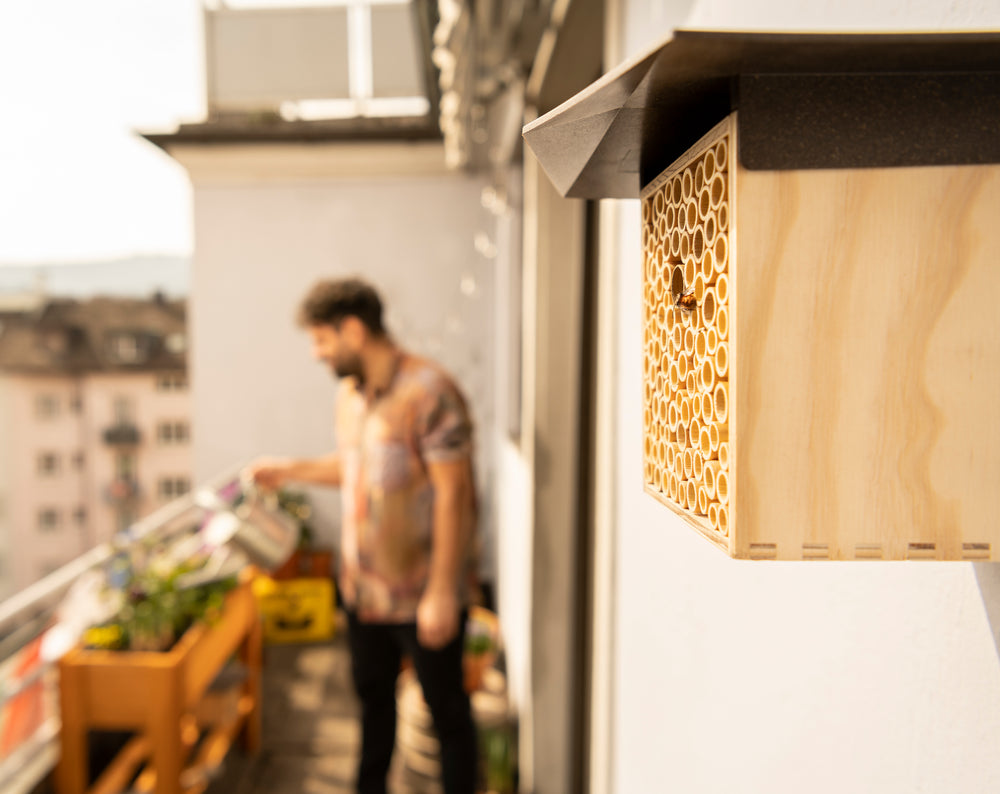
Many important food plants for mason bees also blossom in the city throughout the spring. Therefore, a location in the city is very suitable for a BeeHome. You can also place your BeeHome on a balcony of a multi-story building. Mason bees fly up to 300 meters in search of food. To support the wild bees, we recommend planting native and wild bee-friendly plants on your balcony.
BeeHome Installation: A Step-by-Step Guide
The Red Mason Bee and the Horned Mason Bee are lowland bees. For climatic reasons, successful reproduction above approximately 1300 m above sea level is difficult. If there are still fruit trees or wild bee-friendly plants above 1300 m above sea level, successful settlement should be possible.
Nobody needs to worry about their pets. Wild bees are naturally peaceful and only want one thing: to collect pollen for their offspring as undisturbed as possible and bring it to their nest, i.e., the BeeHome. As long as your dog or cat leaves the wild bees alone, the industrious pollinators will not be interested in them or bother them.
Tip: Hang the BeeHome high enough
Of course, like all insects, wild bees are interesting for dogs and cats, also as play or hunting objects. It can happen that a mason bee female stings a curious pet in self-defense. Such a sting is harmless to the animal and at most causes a brief moment of fright. We recommend hanging the BeeHome high enough so that the flight path of the wild bees is out of reach of your dog or cat.
You can easily support birds with water dishes and feeding stations – even though they are higher up in the food chain than wild bees. It may not sound logical, but it's easy to explain: Birds are part of biodiversity and will visit your garden even if you don't offer seeds or water. Furthermore, these feeding stations primarily attract bird species that only occasionally catch insects in flight and therefore pose no danger to active mason bees.
Two important rules help wild bees
Nevertheless, when installing feeding stations and bird baths, you should keep two things in mind to avoid unnecessarily endangering your mason bees:
- Choose a shallow dish: Should individual wild bees fly into the dish, they can easily leave it. Placing stones or branches in the water also helps.
- Do not place the feeding station under the BeeHome: This ensures that your mason bees do not fall into the feeding station.
During the mason bee flight season (approx. March to June), the BeeHome should remain in its location. If this is not possible, we recommend relocating it at night, as the bees sleep inside the BeeHome then. It can happen that the mason bees are disoriented for a few days and have difficulty finding the BeeHome; they may even look for a new home in the meantime.
If you want to relocate the BeeHome outside of the mason bee flight season, that's no problem at all. If you are moving, the only important thing is that the BeeHome doesn't sit indoors for too long. It's best to pack it last when everything else is packed and hang it outside first in your new home.
Moving during the flight season (March-June):
It's best to order the starting population after you've moved, so the solitary bees can hatch directly in their new home.
If this isn't possible, we recommend wrapping the BeeHome in foil the night before the move (when it's dark and the bees are no longer flying in and out) and ideally transporting it to the new location promptly. Make sure the BeeHome isn't shaken too much and is mounted directly outdoors at the new location.
Moving after the flight season (July-August):
Inside the tubes are the solitary bee larvae, which develop into bees and pupate by autumn. The larvae are more sensitive and should not be exposed to strong vibrations. So, when moving during this time, make sure the BeeHome isn't shaken too much and place it back outdoors on the same day.
Moving after the flight season (September-February):
Moving during this period is generally not a problem. Please ensure that the occupied BeeHome is placed or hung outdoors promptly.