


Wild Bee Nesting Aids:
How to care for your bee hotel
Are you attached to your BeeHome and your wild bees and would like to spoil them? With moisture and over the years, the wood can turn black and mold can appear. Here are some tips on how to care for your BeeHome.
To avoid disturbing the wild bees, we recommend that you carry out this maintenance when they are in hibernation - ideally between September and January.
Maintain the location of your BeeHome
To avoid the phenomenon of blackening, the location is very important. If your BeeHome turns black too quickly, your house is undoubtedly too exposed to the elements.
We recommend an installation more than 1 m above the ground, facing east to south (ideally an orientation with morning sun). A tree, complete shade, or a humid environment should definitely be avoided. If you continue to have problems with mold, you can try relocating the house so that it gets more sun. You can install a protective wall to protect it from heavy rain and wind. This is especially true if you have set up your BeeHome in the garden.
Video: BeeHome care in autumn – step by step
In this video, we show you how to properly care for your BeeHome in autumn: from cleaning and linseed oil wood treatment to replacing the nesting tubes. This way, your BeeHome remains a safe nesting site for wild bees, and you support the new generation in spring.
Maintaining a Bee Hotel Step-by-Step
1. Open your BeeHome
The procedure depends on the model:
- BeeHome Observer: Unscrew the roof and carefully remove the side panels.
- BeeHome Classic: Tilt slightly backward and pull the roof upwards.
2. Cleaning and Wood Care
Place your BeeHome with the tube side facing up on a solid surface. Remove coarse dirt with a brush. For a nice finish, you can sand the wood – first with a coarse grit (80–100), then finer (180–240). Always sand in the direction of the grain.
3. Protect the wood with linseed oil
Our wood is untreated and therefore absorbs moisture easily. Linseed oil seals the pores, smooths the surface, and protects your wild bee house long-term.
- The wood must be absolutely dry and clean.
- Apply two coats of linseed oil – let the first coat dry thoroughly (approx. 24 hours), then apply the second coat.
This will keep your BeeHome durable and weather-resistant.
4. Check and replace nesting tubes
Over time, old brood residues, mold, or parasites accumulate in the tubes. That's why replacing the tubes is so important.
- Carefully remove old tubes by hand or with small pliers.
- Check for visible caps or escape holes. If unsure, place the tubes outdoors in a sheltered spot – never throw them away.
- Mold at the entrances is harmless to wild bees, but you can carefully remove it with a brush or sandpaper.
- Mark newly capped tubes with a green dot each year – this way you can quickly see if they are occupied. In our video tutorial on tube marking, we show you step-by-step how it works.
Additionally, you can restock your BeeHome with our replacement tubes made of giant reed (Arundo donax) – specially developed for wild bees.
5. Insert new tubes
When inserting the replacement tubes, keep the following in mind:
- Entrances must be smooth → rework with sandpaper if necessary.
- The natural knot (internode) points backward.
- Place tubes tightly and stably, gently tapping them in with a rubber mallet if necessary.
Replacement tubes can be found directly in our shop: Order replacement tubes.
6. Solve common problems
- Drawer difficult to open (BeeHome Observer): Caused by swollen wood. Solution: let it dry, lightly sand the drawer sides, remove dust, apply linseed oil. The drawer will then slide smoothly again.
- Black wood: Your BeeHome is too damp or shady. Relocate it – at least 50 cm above the ground, protected from the weather, facing east to south.
- Mold problems: Change location or install an additional protective wall against rain/wind.
7. Proper winter storage for your BeeHome
When the days get shorter and no more bees are flying, you can place your BeeHome in a rain-protected location. Important: do not bring it indoors – wild bees need the natural cold to remain safely in hibernation.
With this autumn care, your wild bee house will remain stable, clean, and safe for a long time – and you ensure that your bees can start healthy again in spring.


Perfect for your BeeHome
Replacement tubes made of giant cane
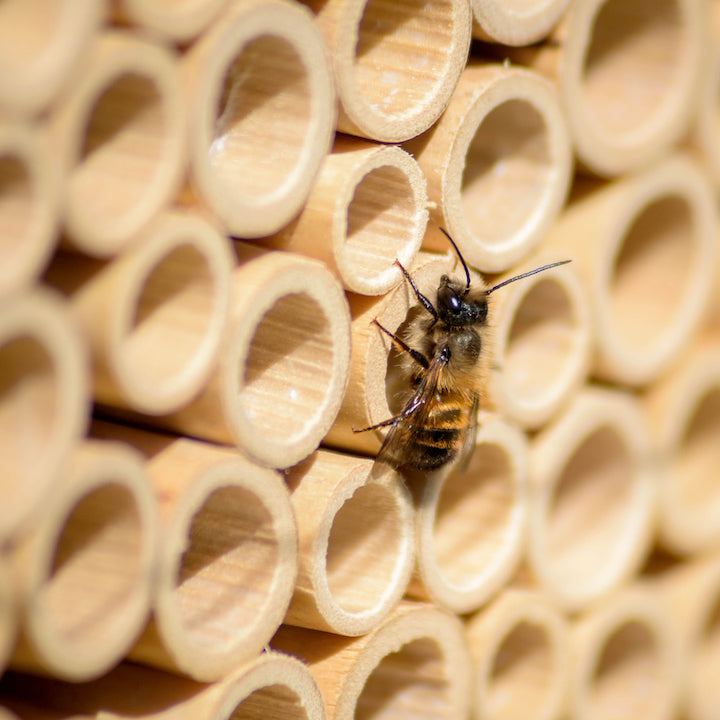
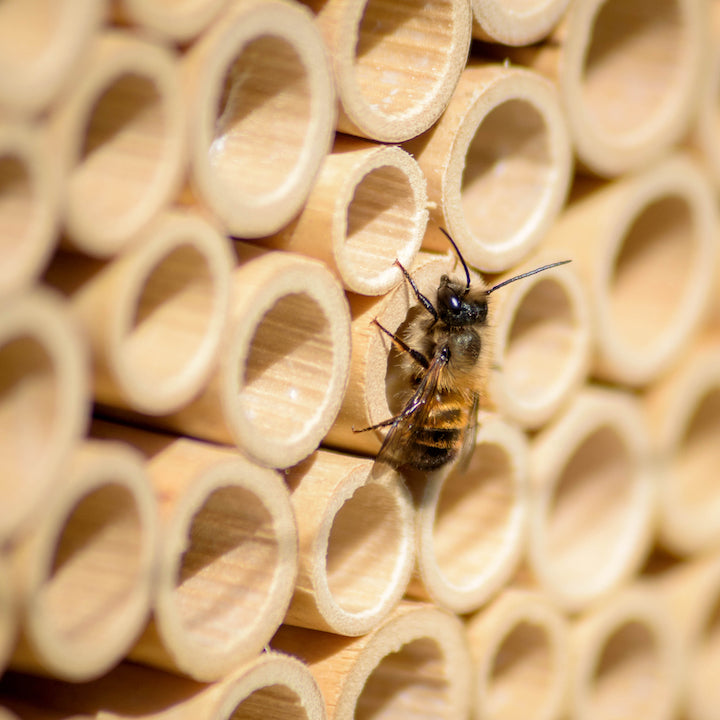
With the replacement tubes made of giant reed, you can restock your BeeHome or replace individual nesting tubes. Giant reed (bot. Arundo donax), also known as Spanish cane, is ideal as nesting material for the mason bees in your BeeHome. Unlike common reed, the thickness of the giant reed limits the spread of parasites and parasitic wasps between nests and protects the offspring.
The tubes have a diameter between 5 and 11 millimeters and a length of more than 13 centimeters – perfect for the needs of the mason bees, whose cocoons you can order with your BeeHome. Approximately 20 other wild bee species can nest in the nesting tubes.
Professional care and overwintering of your mason bees
Have you ever wondered how many mason bees you've propagated or if other inhabitants have settled in your BeeHome?
Our wild bee care in autumn includes:
- Removing parasites
- Hibernating mason bee cocoons
- Recording nesting success
- Replacing nesting tubes
- Starter population for next season (min. 30 cocoons)